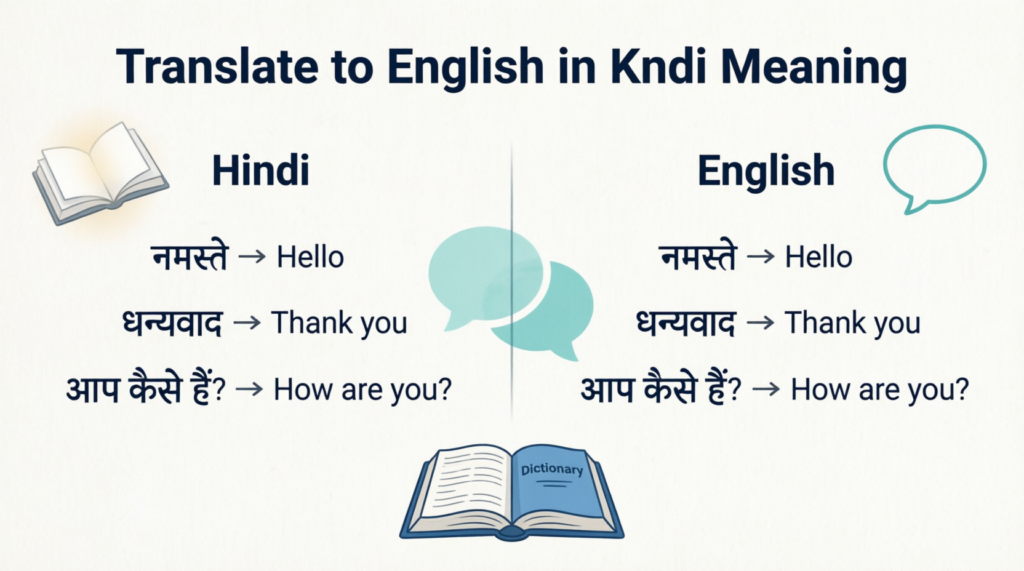
“Translate to English in Hindi meaning” usually means understanding how to translate a Hindi word, sentence, or phrase into English and learning its meaning in Hindi. For example, “आप कैसे हैं?” translates to “How are you?” in English. In Hindi, its meaning is “आपका हाल कैसा है?”
Translate to English in Hindi Meaning & Definition
The phrase “translate to English in Hindi meaning” is commonly used by people who want to understand English translations while learning Hindi meanings. It combines two related language-learning needs: converting Hindi text into English and understanding English words or sentences in Hindi.
The exact meaning depends on what the person wants to translate.
- Hindi to English translation: Changing Hindi words or sentences into English.
- English meaning in Hindi: Explaining an English word or sentence in Hindi.
- Word-by-word translation: Translating individual words from one language into another.
- Sentence translation: Converting a complete sentence while preserving its intended meaning.
- Contextual translation: Choosing natural words based on the situation, tone, and purpose.
For example:
| Hindi sentence | English translation | Hindi meaning explained |
|---|---|---|
| नमस्ते | Hello | किसी का अभिवादन करना |
| आप कैसे हैं? | How are you? | किसी का हाल पूछना |
| मुझे पानी चाहिए। | I need water. | पानी की आवश्यकता होना |
| मैं स्कूल जा रहा हूँ। | I am going to school. | स्कूल जाने की क्रिया बताना |
| धन्यवाद। | Thank you. | आभार व्यक्त करना |
| मुझे समझ नहीं आया। | I did not understand. | किसी बात को न समझ पाने की स्थिति |
The main purpose is to make communication between Hindi and English easier. A good translation should communicate the original message clearly rather than simply replacing each word with its dictionary equivalent.
Introduction
Have you ever read an English sentence and understood a few words but struggled to understand the complete meaning? Or perhaps you wanted to write something in English but could express your thoughts more easily in Hindi.
This is where Hindi-to-English translation becomes useful.
People search for phrases such as “translate to English in Hindi meaning,” “Hindi to English translation,” “English meaning in Hindi,” and “translate Hindi sentences into English” when they need quick, understandable language support.
Students may use translations to complete assignments, professionals may need them for emails, and beginners may rely on them to learn everyday English. Travelers and people communicating online also benefit from understanding common expressions in both languages.
However, translation involves more than knowing individual words. The same word may have different meanings depending on its context, and a sentence that sounds natural in Hindi may require a different structure in English.
For example, the Hindi sentence “मुझे भूख लगी है” is naturally translated as “I am hungry.” Translating each word literally would produce an awkward English sentence.
In this guide, you will learn how to translate Hindi into English, understand English meanings in Hindi, recognize common translation mistakes, and use practical examples to improve your language skills.
Origin of Hindi-to-English Translation
Translation between Hindi and English has a long history connected with education, literature, administration, trade, and communication between communities.
Hindi developed from earlier Indo-Aryan language traditions, while English belongs to the Germanic branch of the Indo-European language family. Although the two languages share some distant historical linguistic connections, their grammar, vocabulary, and sentence structures differ considerably.
As contact between Hindi-speaking communities and English-speaking institutions increased, translation became important in education, publishing, government, business, and everyday communication.
Today, Hindi-to-English translation is used in schools, universities, workplaces, websites, mobile applications, and digital communication.
Read This Pronóstico Meaning in English: Definition, Examples, and Spanish Usage
How Translation Has Changed

Traditional dictionaries: Learners looked up individual words in printed dictionaries to understand meanings and spelling.
Language textbooks: Students practiced translating sentences, paragraphs, stories, and grammatical structures.
Online dictionaries: Digital resources made it easier to search for meanings, pronunciations, synonyms, and example sentences.
Machine translation: Translation software began helping users convert larger amounts of text between languages.
AI-powered language tools: Modern systems can often explain context, suggest natural phrasing, and help users compare formal and informal expressions.
These developments have made translation more accessible. Still, automated translations may misunderstand idioms, regional expressions, sarcasm, or specialized terminology. Human judgment remains valuable when accuracy and tone matter.
Popularity of Hindi-to-English Translation
Hindi-to-English translation is useful for people learning English, communicating with English speakers, studying academic material, and working in multilingual environments.
English is widely used in international business, higher education, science, technology, and online communication. Hindi, meanwhile, is spoken by millions of people, particularly in India and by Hindi-speaking communities around the world.
This creates many situations in which people need to move between the two languages.
Why People Search for Hindi and English Meanings
1. Learning English vocabulary
Beginners often understand new English words more easily when they can compare them with familiar Hindi meanings.
Example: “Honest” means “ईमानदार.”
2. Understanding sentences
A Hindi explanation can help learners understand the meaning of a complete English sentence rather than memorizing isolated words.
3. Improving spoken English
Learners may translate familiar Hindi expressions into natural English before using them in conversation.
4. Writing emails and messages
People may draft a message in Hindi and translate it into English for a professional or academic setting.
5. Understanding online content
English websites, tutorials, news articles, and educational videos may be easier to understand with Hindi explanations.
6. Preparing for examinations
Students frequently practice translation to improve vocabulary, grammar, reading comprehension, and writing.
Translation is particularly useful when combined with regular reading, listening, speaking, and writing practice. Understanding a sentence in Hindi is a helpful first step, but learning how to construct similar sentences independently is what builds lasting fluency.
How to Translate Hindi Into English
Translating Hindi sentences into English becomes easier when you follow a consistent method.
Step 1: Understand the Complete Sentence
Read the entire Hindi sentence before translating it. Identify what the speaker wants to communicate.
For example:
Hindi: मुझे आज काम करना है।
English: I have to work today.
The sentence expresses an obligation, not merely a future action.
Step 2: Identify the Subject and Verb
Determine who is performing the action and what is happening.
Hindi: वह किताब पढ़ रही है।
English: She is reading a book.
The subject is “she,” and the action is “is reading.”
Step 3: Choose the Correct Tense
English grammar often requires specific tense structures.
| Hindi sentence | English translation | Tense or structure |
|---|---|---|
| मैं पढ़ता हूँ। | I study. | Simple present |
| मैं पढ़ रहा हूँ। | I am studying. | Present continuous |
| मैंने पढ़ा। | I studied. | Simple past |
| मैं पढ़ूँगा। | I will study. | Simple future |
| मैंने पढ़ लिया है। | I have finished studying. | Present perfect with completion |
The best translation depends on the intended meaning and context.
Step 4: Use Natural English Word Order
Hindi often follows a subject-object-verb pattern, while ordinary English statements commonly follow a subject-verb-object pattern.
Hindi: मैं चाय पीता हूँ।
Literal order: I tea drink.
Natural English: I drink tea.
Avoid carrying Hindi word order directly into English when it produces an unnatural sentence.
Step 5: Check the Meaning and Tone
After translating, ask whether the English sentence communicates the same message.
For example:
Hindi: कृपया मेरी मदद कीजिए।
English: Please help me.
The translation preserves the polite request.
In a professional email, you might instead write, “Could you please help me with this?”
Both are correct, but the second may be more suitable for a formal situation.
Hindi-to-English Translation Examples
The following examples cover everyday conversations, education, work, and informal communication.
Friendly Examples

These expressions are useful when speaking with friends, family members, or acquaintances.
| Hindi | English | When to use it |
|---|---|---|
| आप कैसे हैं? | How are you? | Greeting someone |
| मैं ठीक हूँ। | I am fine. | Responding to a greeting |
| तुम क्या कर रहे हो? | What are you doing? | Asking about someone’s activity |
| मुझे तुमसे बात करनी है। | I need to talk to you. | Starting a conversation |
| बहुत अच्छा! | That’s great! | Showing excitement |
| कोई बात नहीं। | No problem. | Reassuring someone |
| मुझे खुशी हुई। | I am glad. | Expressing happiness |
| फिर मिलते हैं। | See you again. | Saying goodbye |
| अपना ध्यान रखना। | Take care of yourself. | Expressing concern |
| मुझे यह पसंद है। | I like this. | Expressing a preference |
Professional Examples
Read This Tagalog in English Words With Meaning: 100+ Everyday Filipino Words to Learn
Professional communication often requires complete sentences, polite requests, and precise vocabulary.
| Hindi | English | Context |
|---|---|---|
| कृपया मुझे जानकारी भेजें। | Please send me the information. | Requesting details |
| मैं आपकी प्रतिक्रिया का इंतज़ार करूँगा। | I will wait for your feedback. | Following up |
| क्या हम बैठक निर्धारित कर सकते हैं? | Can we schedule a meeting? | Arranging a meeting |
| मैं इस विषय पर चर्चा करना चाहता हूँ। | I would like to discuss this matter. | Starting a formal discussion |
| कृपया संलग्न दस्तावेज़ देखें। | Please review the attached document. | Sending an email |
| मैं समय पर काम पूरा कर दूँगा। | I will complete the work on time. | Discussing a deadline |
| आपके सहयोग के लिए धन्यवाद। | Thank you for your cooperation. | Expressing appreciation |
| क्या आप इसे स्पष्ट कर सकते हैं? | Could you clarify this? | Asking for an explanation |
In formal writing, phrases such as “I would appreciate your assistance” or “Could you please clarify this point?” may sound more polished than direct translations of casual Hindi requests.
Funny Examples
Informal and humorous expressions often depend on context, so the translation should preserve the joke rather than follow every word literally.
| Hindi expression | Natural English equivalent | Meaning |
|---|---|---|
| मेरा दिमाग काम नहीं कर रहा। | My brain isn’t working. | Feeling mentally tired or confused |
| आज मेरा आलस जीत गया। | Laziness won today. | Joking about procrastination |
| मैं खाने के लिए हमेशा तैयार हूँ। | I am always ready to eat. | Expressing a love of food |
| मेरा बिस्तर मुझे बुला रहा है। | My bed is calling me. | Feeling sleepy or wanting to rest |
| पढ़ाई और मेरा पुराना झगड़ा है। | Studying and I have a long-standing feud. | Joking about disliking studying |
These are playful equivalents rather than strict word-for-word translations. Humor, exaggeration, and cultural references often need to be adapted for the target language.
Comparison With Similar Translation Terms
People sometimes use “translation,” “meaning,” “interpretation,” and “transliteration” as if they were identical. They are related, but each has a distinct purpose.
| Term | Meaning | Example |
|---|---|---|
| Translation | Expressing meaning in another language | नमस्ते → Hello |
| Meaning | Explaining what a word or sentence communicates | Honest → ईमानदार |
| Transliteration | Representing words using another writing system | नमस्ते → Namaste |
| Interpretation | Explaining or conveying intended meaning, often in context | Explaining an idiom in natural English |
| Paraphrasing | Restating an idea in different words in the same language | “I am tired” → “I feel exhausted” |
| Localization | Adapting content for a particular audience or culture | Adjusting a website’s language and date formats |
Translation vs. Meaning
Translation converts a word or sentence into another language. Meaning explains what the word or sentence communicates.
For example, translating “धन्यवाद” gives “Thank you.” Explaining its meaning in Hindi would be “किसी के प्रति आभार व्यक्त करना।”
Translation vs. Transliteration
Transliteration changes the writing system without necessarily translating the meaning.
For example:
- Hindi: धन्यवाद
- Transliteration: Dhanyavaad
- English translation: Thank you
“Dhanyavaad” is the Hindi word written in Latin letters. It is not the English translation.
Literal Translation vs. Natural Translation
Literal translation follows the original wording closely. Natural translation expresses the same idea in a way that sounds appropriate in the target language.
For example:
Hindi: मेरा पेट भर गया है।
Literal translation: My stomach has become full.
Natural English: I am full.
The natural version is generally better for everyday conversation.
Alternate Meanings and Uses of Translate to English in Hindi Meaning
The phrase “translate to English in Hindi meaning” is not a fixed technical term with only one definition. People use it to describe several related translation tasks.
Hindi to English Translation
This means converting Hindi words, sentences, or paragraphs into English.
Example:
Hindi: मुझे अंग्रेज़ी सीखनी है।
English: I want to learn English.
English to Hindi Meaning
This means explaining an English word or sentence in Hindi.
Example:
English: Confidence.
Hindi meaning: आत्मविश्वास।
English Sentences With Hindi Explanations
Some learners want an English sentence alongside its Hindi meaning to understand grammar and usage.
Example:
English: Practice makes perfect.
Hindi meaning: अभ्यास से निपुणता आती है।
This translation communicates the proverb’s intended message rather than copying its exact structure.
Hindi Words Written in English Letters
Some users want Hindi written in the Latin alphabet so they can read or type it more easily.
Example:
Hindi: आप कैसे हैं?
Romanized Hindi: Aap kaise hain?
This is transliteration or romanization, not translation into English.
Read This 444 Tattoo Meaning: Symbolism, Spiritual Signs, and Powerful Design Ideas
Voice and Image Translation

People may also use translation tools to understand spoken Hindi, translate text in photographs, or convert written English into Hindi explanations.
These are different methods of accessing language meaning, and the best method depends on whether the original content is written, spoken, or displayed in an image.
Professional or Polite Alternatives
The wording you choose depends on whether you are speaking casually, asking someone for help, or describing a translation task professionally.
| Situation | Natural English phrase |
|---|---|
| Casual request | Translate this into English. |
| Asking for Hindi meaning | What does this mean in Hindi? |
| Requesting an explanation | Could you explain the meaning in Hindi? |
| Formal request | Could you please translate this into English? |
| Academic setting | Please provide an English translation of this passage. |
| Workplace communication | Could you translate this message into English for me? |
| Asking for context | Could you explain the meaning and usage of this expression? |
| Requesting natural wording | Could you provide a natural English equivalent? |
Which Phrase Should You Use?
Use “Translate this into English” when you want Hindi text converted into English.
Use “What does this mean in Hindi?” when you have an English word or sentence and need a Hindi explanation.
Use “Could you provide a natural English translation?” when you want wording that sounds fluent rather than literal.
For professional or academic tasks, it can also help to specify whether you want a formal tone, simple English, or a word-by-word explanation.
Common Mistakes in Hindi-to-English Translation
Learning to translate effectively involves recognizing common errors and understanding how to correct them.
1. Translating Every Word Literally
A literal translation may be grammatically incorrect or sound unnatural.
Incorrect: “I am having 20 years.”
Natural English: “I am 20 years old.”
Hindi speakers may use a different grammatical structure when expressing age, so the English sentence must follow English conventions.
2. Using the Wrong Tense
Hindi and English do not always use tense and aspect in identical ways.
Hindi: मैं दो घंटे से पढ़ रहा हूँ।
Natural English: I have been studying for two hours.
The English present perfect continuous emphasizes an activity that began earlier and continues into the present.
3. Ignoring Context
A single English word may have several Hindi meanings.
For example, “light” can mean “रोशनी” when referring to illumination or “हल्का” when describing weight.
Always check the sentence before choosing a translation.
4. Confusing Transliteration With Translation
Writing “Paani” instead of “पानी” changes the script, not the language.
The English translation of “पानी” is “water.”
5. Choosing Informal Words for Formal Situations
A casual expression may not be appropriate in a business email.
Instead of “Send me this quickly,” a more polite alternative is “Could you please send this to me at your earliest convenience?”
Choose the tone according to your audience and purpose.
6. Ignoring Singular and Plural Forms
English nouns and verbs may change according to whether the subject is singular or plural.
Incorrect: “She go to school.”
Correct: “She goes to school.”
Checking subject-verb agreement helps make translations grammatically accurate.
7. Forgetting Cultural Expressions
Idioms and proverbs often cannot be translated word for word.
For example, “आँखों का तारा” literally refers to the pupil or star of the eyes in an affectionate expression. A natural English equivalent might be “the apple of someone’s eye.”
The best choice preserves the expression’s intended emotional meaning.
Quick Tips for Better Hindi-to-English Translation

Use these practical techniques to improve your translation skills.
- Read the complete sentence first. Understand the message before translating individual words.
- Check the context. Determine whether the text is casual, academic, professional, or humorous.
- Learn phrases, not just vocabulary. Common expressions help you create more natural sentences.
- Practice English word order. Start with the subject, verb, and object when constructing ordinary English statements.
- Review your tense choices. Check whether the action happens in the present, past, or future.
- Use a reliable dictionary. Look for example sentences, pronunciation, and different meanings.
- Compare literal and natural translations. This helps you recognize when English requires a different structure.
- Read the final sentence aloud. If it sounds unnatural, reconsider the wording.
- Keep a vocabulary notebook. Record the English word, Hindi meaning, and one example sentence.
- Practice daily. Translating a few sentences each day can build confidence over time.
The goal is not to translate every sentence perfectly on the first attempt. It is to understand the message and gradually learn how English expresses the same ideas.
FAQ: Translate to English in Hindi Meaning
1. What does “translate to English in Hindi meaning” mean?
It usually refers to translating Hindi text into English or understanding English words and sentences through Hindi explanations. The intended direction depends on the text and the user’s request.
2. How can I translate Hindi into English?
Read the Hindi sentence, identify its meaning, choose the correct English vocabulary and tense, and arrange the words naturally. Review the final sentence to ensure it communicates the original message accurately.
3. How can I find the Hindi meaning of an English word?
Look up the English word in a reliable bilingual dictionary or translation tool. Check its context and example sentences because a word may have multiple Hindi meanings.
4. What is the difference between translation and meaning?
Translation expresses a word or sentence in another language. Meaning explains what the word, sentence, or expression communicates. A translation can provide the meaning, but an explanation may offer additional context.
5. Can I translate a complete Hindi sentence into English?
Yes. You can translate complete sentences, paragraphs, messages, and longer documents. For accurate results, consider grammar, context, tone, and any cultural expressions in the original text.
6. Is word-by-word translation accurate?
Not always. Word-by-word translation can help beginners understand vocabulary, but it may produce unnatural or incorrect sentences. Translating the intended meaning is usually more effective for everyday communication.
7. What is the difference between translation and transliteration?
Translation changes the language while preserving the intended meaning. Transliteration represents words using a different writing system. For example, “पानी” becomes “water” through translation and “paani” through transliteration.
8. How can I improve my Hindi-to-English translation skills?
Practice daily with short sentences, learn common expressions, study English grammar, read simple English material, and compare your translations with natural examples. Gradually move from individual sentences to paragraphs and professional writing.
9. Can translation tools understand Hindi idioms?
Many modern translation tools can translate common idioms, but they may struggle with cultural references, sarcasm, regional expressions, and unusual wording. Check the context and use a natural English equivalent when a literal translation does not make sense.
10. How do I translate English into Hindi for professional use?
Identify the message, audience, and required tone before translating. Use appropriate Hindi vocabulary and grammar, preserve the original meaning, and review the result for clarity. For legal, medical, or other high-stakes documents, qualified human review may be necessary.
Conclusion
The phrase “translate to English in Hindi meaning” reflects a common language-learning need: understanding how words and sentences move between Hindi and English.
Successful translation requires more than replacing words. It involves understanding context, selecting the right vocabulary, using correct grammar, and preserving the original tone.
Start with familiar everyday expressions, practice complete sentences, and compare literal translations with natural English equivalents. Use Hindi explanations to build understanding, but also practice constructing English sentences independently.
With consistent practice, you can improve your vocabulary, understand English content more confidently, and communicate more naturally in both languages.