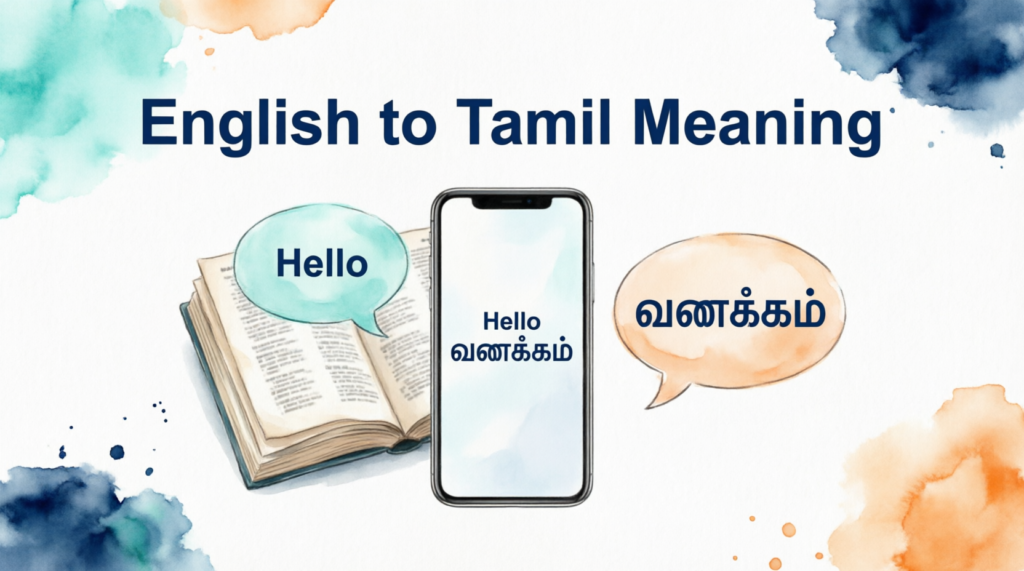
“English to Tamil meaning” refers to translating English words, phrases, or sentences into Tamil so that Tamil speakers can understand their meanings clearly. It helps learners improve vocabulary, understand conversations, and communicate naturally in everyday, educational, and professional situations.
English to Tamil Meaning: Meaning and Definition
The phrase English to Tamil meaning is commonly searched by people who want to understand English words or sentences in Tamil. Tamil is a classical language spoken mainly in the Indian state of Tamil Nadu, Sri Lanka, Singapore, and Tamil-speaking communities around the world.
For example, someone who wants to understand the English word “love” can look for its Tamil meaning, காதல் (Kaadhal). Similarly, “Thank you” can be translated as நன்றி (Nandri).
English-to-Tamil translation involves converting the meaning of English text into Tamil. However, good translation does not simply replace each English word with a Tamil word. It also considers grammar, context, tone, and the relationship between the speaker and listener.
Here are a few simple examples:
- English: Hello
- Tamil: வணக்கம் (Vanakkam)
- English: How are you?
- Tamil: நீங்கள் எப்படி இருக்கிறீர்கள்? (Neengal eppadi irukkireergal?)
- English: I am happy.
- Tamil: நான் மகிழ்ச்சியாக இருக்கிறேன். (Naan magizhchiyaga irukkiren.)
- English: Good morning
- Tamil: காலை வணக்கம் (Kaalai vanakkam)
These examples demonstrate how translation can make English expressions easier to understand for Tamil speakers. Learning both the Tamil script and its Roman transliteration can also help beginners read and pronounce unfamiliar words.
Introduction
Have you ever read an English message and wanted to know exactly what it meant in Tamil? Perhaps you came across a new word while studying, received an English message from a friend, or needed to understand an instruction at work. English-to-Tamil translation can help you understand the message without losing its main idea.
English is widely used in education, business, technology, travel, and online communication. Tamil speakers often encounter English through websites, mobile applications, textbooks, social media, and professional documents. Knowing the Tamil meaning of unfamiliar English words makes this information more accessible.
For students, translation can help explain difficult vocabulary and textbook passages. For professionals, it can support communication with Tamil-speaking customers and colleagues. For language learners, it can provide a practical way to compare English and Tamil grammar.
Consider the English sentence, “I will call you later.” A natural Tamil translation is நான் உங்களைப் பிறகு அழைக்கிறேன் (Naan ungalai piragu azhaikkiren), although the exact wording may change depending on the intended meaning and context.
This example highlights an important point: a translation should communicate the original idea in a way that sounds natural to the target audience.
Whether you want to translate a single word, understand a complete sentence, or improve your language skills, learning English-to-Tamil meanings can make everyday communication easier.
Origin of English-to-Tamil Translation
English-to-Tamil translation has developed through centuries of contact between English-speaking communities and Tamil-speaking populations.
Tamil has a long literary history, with written records extending back more than two thousand years. It has its own grammatical traditions, rich vocabulary, and distinctive writing system. English developed from Germanic languages and later absorbed vocabulary from French, Latin, and other languages.
Read This Translate English to Hindi Meaning: A Simple Guide With Examples
Contact between English and Tamil expanded significantly through trade, missionary activity, colonial administration, education, printing, and publishing. Dictionaries, grammar books, translated religious texts, educational materials, and bilingual publications helped people learn and communicate across the two languages.
As English became important in formal education and employment, Tamil translations also became useful for explaining scientific concepts, administrative information, literature, and everyday expressions.
Modern technology has made translation much more accessible. Printed dictionaries have been supplemented by websites, mobile applications, online glossaries, speech recognition, and artificial intelligence tools. People can now translate short messages or longer passages within seconds.
Despite these changes, the central purpose of translation remains the same: to communicate meaning accurately while respecting the structure and natural expressions of both languages.
Popularity of English-to-Tamil Meaning Searches
English-to-Tamil translation is popular because people regularly use both languages in education, work, entertainment, and digital communication.
Tamil speakers may understand conversational English but still need help with unfamiliar vocabulary, complicated instructions, idiomatic expressions, or specialized terminology. Translating these expressions into Tamil can make their meanings easier to understand.
Several factors contribute to the popularity of English-to-Tamil searches.
- Education: Students look up English word meanings to understand lessons, assignments, and examination questions.
- Vocabulary learning: Language learners use translations to remember new words and expressions.
- Social media: Users translate captions, comments, jokes, and messages.
- Professional communication: Employees may need to understand emails, instructions, and customer requests.
- Travel: Visitors use translations to understand directions, signs, and common questions.
- Digital accessibility: Tamil translations help people access information originally published in English.
- Entertainment: Viewers may look for Tamil meanings of English dialogue, song titles, film expressions, and online trends.
Search phrases such as “English words with Tamil meaning,” “English sentences translated into Tamil,” and “English to Tamil dictionary” reflect different learning needs.
However, automatic translation is not always perfect. Idioms, sarcasm, regional expressions, and technical terms may require additional explanation. Checking context and choosing natural Tamil wording are important parts of accurate translation.
How English-to-Tamil Translation Is Used
English-to-Tamil translation can be used in many situations. The method you choose should depend on whether you are translating a word, a conversation, or a formal document.
1. Translating Individual English Words
Single-word translation is useful when learning vocabulary or reading an unfamiliar sentence.
| English word | Tamil meaning | Roman transliteration |
|---|---|---|
| Love | காதல் | Kaadhal |
| Water | தண்ணீர் | Thanneer |
| Friend | நண்பர் | Nanbar |
| Family | குடும்பம் | Kudumbam |
| Happiness | மகிழ்ச்சி | Magizhchi |
| Knowledge | அறிவு | Arivu |
| Beautiful | அழகான | Azhagaana |
| Success | வெற்றி | Vetri |
| Peace | அமைதி | Amaithi |
| Hope | நம்பிக்கை | Nambikkai |
Some English words have several Tamil equivalents. For example, “friend” may be expressed differently depending on gender, familiarity, or sentence structure. The best translation depends on how the word is being used.
2. Translating Complete Sentences
Translating full sentences helps preserve context and grammatical relationships.
| English sentence | Tamil translation | Roman transliteration |
|---|---|---|
| I am learning English. | நான் ஆங்கிலம் கற்றுக்கொண்டு இருக்கிறேன். | Naan aangilam katrukkondu irukkiren. |
| Where are you going? | நீங்கள் எங்கே செல்கிறீர்கள்? | Neengal enge selgireergal? |
| Please help me. | தயவுசெய்து எனக்கு உதவுங்கள். | Thayavuseithu enakku uthavungal. |
| I am very tired. | நான் மிகவும் சோர்வாக இருக்கிறேன். | Naan migavum sorvaaga irukkiren. |
| What is your name? | உங்கள் பெயர் என்ன? | Ungal peyar enna? |
| I need some water. | எனக்கு கொஞ்சம் தண்ணீர் வேண்டும். | Enakku konjam thanneer vendum. |
| See you tomorrow. | நாளை சந்திப்போம். | Naalai sandhippom. |
| Thank you for your help. | உங்கள் உதவிக்கு நன்றி. | Ungal uthavikku nandri. |
The translations above use generally understandable forms. Everyday spoken Tamil may use shorter or different expressions, depending on the region and relationship between speakers.
3. Translating Messages and Conversations
Translation is especially useful when communicating with someone who prefers Tamil.
For example:
- English: I will reach home in ten minutes.
- Tamil: நான் பத்து நிமிடங்களில் வீட்டை அடைவேன்.
- English: Please wait for me.
- Tamil: தயவுசெய்து எனக்காகக் காத்திருங்கள்.
- English: I will call you when I arrive.
- Tamil: நான் வந்ததும் உங்களை அழைக்கிறேன்.
When translating messages, preserve the original intention. A friendly message should not suddenly sound like a formal announcement, and a professional request should not become overly casual.
English-to-Tamil Translation Examples
Examples help learners understand how translation changes according to context, tone, and purpose.
Friendly Examples
Friendly Tamil expressions are useful when speaking with friends, relatives, classmates, or people you know well.
| English expression | Tamil meaning | Tone |
|---|---|---|
| Hi, friend! | வணக்கம், நண்பா! | Friendly |
| How was your day? | உங்கள் நாள் எப்படி இருந்தது? | Interested |
| Don’t worry. | கவலைப்படாதே. | Reassuring, informal |
| I miss you. | உன்னை நினைக்கிறேன். | Affectionate |
| That’s awesome! | அது அருமை! | Excited |
| Let’s go together. | நாம் ஒன்றாகச் செல்வோம். | Inviting |
| Take care. | பத்திரமாக இரு. | Caring, informal |
| See you soon. | விரைவில் சந்திப்போம். | Warm |
Tamil expressions can change according to age, familiarity, and regional speech patterns. For example, the wording used with a close friend may differ from the wording used with an older relative.
Professional Examples
Professional communication generally requires respectful, clear, and appropriately formal language. These translations may be useful for workplace messages, customer service, and academic communication.
| English sentence | Tamil translation | Purpose |
|---|---|---|
| Please send the report. | தயவுசெய்து அறிக்கையை அனுப்புங்கள். | Polite request |
| Thank you for your support. | உங்கள் ஆதரவுக்கு நன்றி. | Appreciation |
| Could you explain this again? | இதை மீண்டும் விளக்க முடியுமா? | Respectful question |
| I will contact you tomorrow. | நான் நாளை உங்களைத் தொடர்புகொள்கிறேன். | Follow-up |
| We appreciate your feedback. | உங்கள் கருத்துகளை நாங்கள் மதிக்கிறோம். | Professional appreciation |
| Please let me know if you need assistance. | உங்களுக்கு உதவி தேவைப்பட்டால் தயவுசெய்து எனக்குத் தெரிவிக்கவும். | Customer support |
| I will review the document. | நான் ஆவணத்தைப் பரிசீலிப்பேன். | Workplace communication |
For professional documents, consistency matters. Names, dates, figures, technical terms, and commitments should remain accurate. If the document has legal, medical, or official significance, a qualified translator may be needed.
Funny Examples

Humour is often difficult to translate because jokes can depend on English wordplay, cultural references, or double meanings. A natural Tamil adaptation may communicate the joke better than a literal translation.
| English joke | Tamil adaptation | Explanation |
|---|---|---|
| I’m on a seafood diet. I see food and eat it. | உணவு கண்ணில் பட்டால் சாப்பிடும் டயட்டில் இருக்கிறேன்! | A playful joke based on the sound of “seafood diet” |
| I’m not lazy; I’m on energy-saving mode. | நான் சோம்பேறி இல்லை; ஆற்றலைச் சேமிக்கும் முறையில் இருக்கிறேன்! | A humorous excuse for resting |
| My bed is my best friend. | என் படுக்கைதான் என் சிறந்த நண்பன்! | A joke about loving sleep |
| I need a vacation from my vacation. | விடுமுறையிலிருந்து ஓய்வெடுக்க இன்னொரு விடுமுறை வேண்டும்! | An exaggerated statement |
The Tamil versions focus on the intended humour rather than matching every English word exactly.
Read This Translate to English in Hindi Meaning: Easy Guide With Examples
Comparison With Similar Terms
Several phrases are used when searching for translations or language-learning resources. Understanding the differences can help you find the most useful information.
| Term | Meaning | Best use |
|---|---|---|
| English to Tamil meaning | The Tamil meaning of English words or expressions | Vocabulary learning |
| English to Tamil translation | Converting English text into Tamil | Sentences, paragraphs, and documents |
| Tamil to English meaning | Finding the English meaning of Tamil words or sentences | Reverse translation |
| English to Tamil dictionary | A reference listing English words and their Tamil equivalents | Looking up vocabulary |
| English to Tamil transliteration | Representing English sounds or words in Tamil script | Pronunciation assistance |
| English to Tamil pronunciation | Learning how words are spoken, often with pronunciation guidance | Speaking practice |
| English to Tamil voice translation | Converting spoken English into Tamil | Conversations and speech-based tasks |
Translation vs. Transliteration
Translation and transliteration serve different purposes.
Translation communicates meaning in another language. Transliteration represents the sound or spelling of a word using a different writing system.
For example:
- English word: Water
- Tamil translation: தண்ணீர் (Thanneer)
- Tamil-script approximation of the English sound: வாட்டர் (Water)
The word “தண்ணீர்” communicates the meaning of water in Tamil. “வாட்டர்” approximates the English pronunciation using Tamil script.
This distinction matters when learning vocabulary. If you want to understand a word, use its Tamil meaning. If you want to reproduce its English sound in Tamil script, transliteration may be more useful.
Translation vs. Pronunciation
Translation explains what a word means, while pronunciation explains how to say it.
For example, “நன்றி” means “Thank you” and is commonly transliterated as “Nandri.” Learning the meaning helps you understand the expression, while learning the pronunciation helps you say it correctly.
Both skills are useful, but they should not be confused.
Alternate Meanings and Common Translation Challenges
The phrase “English to Tamil meaning” usually refers to language translation, but individual English words can have different meanings depending on context.
Consider the word “bank.” It may refer to a financial institution or the land beside a river.
- Bank account: வங்கிக் கணக்கு
- River bank: ஆற்றங்கரை
The surrounding sentence tells you which meaning is intended.
Another example is “right,” which can mean correct, a direction, or a legal entitlement.
- You are right: நீங்கள் சொல்வது சரி.
- Turn right: வலப்புறம் திரும்புங்கள்.
- Human rights: மனித உரிமைகள்.
Other translation challenges include:
- Idioms: “Break the ice” means to make people feel more comfortable, not literally to break ice.
- Gender and grammar: Tamil sentence structure and verb forms differ from English.
- Formality: Tamil uses different expressions depending on respect and familiarity.
- Regional variation: Spoken Tamil differs across Tamil Nadu, Sri Lanka, and other Tamil-speaking communities.
- Technical vocabulary: Medical, legal, and scientific terms may require specialist knowledge.
- Sarcasm: The literal words may not reveal the speaker’s real intention.
- Cultural expressions: Some phrases need adaptation to sound natural in Tamil.
A good translation accounts for these differences rather than treating every word as if it had only one fixed equivalent.
Professional or Polite Alternatives
Choosing respectful language is important when communicating with customers, teachers, colleagues, or people you do not know well.
| Basic English | More polite English | Tamil equivalent |
|---|---|---|
| Send me the file. | Could you please send me the file? | தயவுசெய்து கோப்பை அனுப்ப முடியுமா? |
| Explain this. | Could you explain this to me? | இதை எனக்கு விளக்க முடியுமா? |
| Reply soon. | Please respond when you have a chance. | நேரம் கிடைக்கும்போது தயவுசெய்து பதிலளிக்கவும். |
| I need help. | Could you please assist me? | தயவுசெய்து எனக்கு உதவ முடியுமா? |
| Tell me the details. | Could you please share the details? | விவரங்களைப் பகிர முடியுமா? |
| I disagree. | I understand your point, but I have a different view. | உங்கள் கருத்தைப் புரிந்துகொள்கிறேன், ஆனால் எனக்கு வேறுபட்ட கருத்து உள்ளது. |
A polite translation should preserve the message while avoiding unnecessary harshness. For example, “Give me the answer now” may sound demanding. “Could you please share the answer when possible?” communicates the request more courteously.
In Tamil, respectful wording often uses forms such as “தயவுசெய்து” (please) and “முடியுமா?” (could you?). The most suitable wording depends on the context and how formal the conversation needs to be.
Common Mistakes in English-to-Tamil Translation
Even people who know both languages can make mistakes. Recognizing these common problems can improve translation quality.
Translating Every Word Literally
English and Tamil use different sentence structures and expressions. A direct word-for-word translation may sound awkward or communicate the wrong idea.
Better approach: Understand the complete sentence first, then express its meaning naturally in Tamil.
Ignoring Context
Words with multiple meanings can be translated incorrectly when the surrounding sentence is ignored.
For example, “light bag” refers to a bag that is not heavy, whereas “light in the room” refers to illumination. Context determines the appropriate Tamil word.
Confusing Spoken and Written Tamil
Formal written Tamil may differ from everyday spoken Tamil. A sentence suitable for an official letter may sound unnatural in a casual conversation.
Better approach: Choose vocabulary and grammar that suit your audience and purpose.
Using Transliteration Instead of Translation
Writing an English word in Tamil script does not automatically provide its Tamil meaning.
For example, “வாட்டர்” approximates the sound of “water,” while “தண்ணீர்” is its Tamil equivalent.
Ignoring Tone and Respect
A translation that is acceptable between friends may sound too informal in a workplace or official message.
Better approach: Consider the relationship between the speaker and listener before choosing the final wording.
Trusting Automatic Translation Without Reviewing It
Translation applications can make errors with idioms, names, cultural expressions, and specialized vocabulary.
Better approach: Review the translation against the original. For important content, verify the result with a reliable dictionary or qualified translator.
Read This Tagalog in English Words With Meaning: 100+ Everyday Filipino Words to Learn
Quick Tips for Better English-to-Tamil Translation

Follow these practical tips to make your translations more accurate and natural.
- Translate complete sentences when possible. Full sentences provide useful context.
- Learn vocabulary in phrases. Memorize “Thank you for your help” alongside its natural Tamil equivalent rather than translating every word separately.
- Check multiple meanings. Words such as “bank,” “right,” and “light” have more than one meaning.
- Learn Tamil script gradually. Recognizing Tamil letters can make dictionaries and written translations easier to use.
- Practice pronunciation. Read Tamil translations aloud to become familiar with their sounds.
- Match the tone. Friendly messages, formal emails, and jokes require different language choices.
- Compare reliable sources. Check unfamiliar expressions in a bilingual dictionary or trusted language resource.
- Use translation tools carefully. Treat automatic translations as a starting point, not an unquestionable final answer.
- Study sentence structure. Understanding basic grammar helps you identify unnatural translations.
- Practice every day. Translate a few English sentences, review the results, and record new vocabulary.
A simple exercise is to choose five common English sentences each day, translate them into Tamil, and compare your versions with reliable examples. Over time, you will recognize common expressions and become more confident in both languages.
Frequently Asked Questions
1. What is the meaning of English to Tamil translation?
English-to-Tamil translation means expressing the meaning of English words, phrases, or sentences in Tamil. For example, “Thank you” translates to “நன்றி” (Nandri).
2. How can I translate English words into Tamil?
Identify the English word, check its meaning in context, and find the appropriate Tamil equivalent. A bilingual dictionary or translation application can help. If the word has several meanings, review the complete sentence before choosing a translation.
3. Which is the best English-to-Tamil translation tool?
The best tool depends on your needs. Google Translate and Microsoft Translator can help with many common words and sentences. Bilingual dictionaries are useful for checking vocabulary, while qualified human translators are preferable for important legal, medical, or official documents.
4. What is the difference between English-to-Tamil meaning and translation?
“English-to-Tamil meaning” often refers to finding the Tamil equivalent of a word or expression. “Translation” can describe converting complete sentences, paragraphs, or documents while preserving meaning, tone, and context.
5. Can I translate English sentences into Tamil with pronunciation?
Yes. You can use transliteration or pronunciation guides to understand how Tamil words are spoken. For example, “நன்றி” is commonly written as “Nandri” in Roman letters. Pronunciation tools and audio examples can help you practise speaking.
6. How do I translate English words with multiple meanings into Tamil?
Read the word within its sentence and determine the intended meaning. For example, “bank” can refer to a financial institution or a riverbank. The correct Tamil translation depends on the context.
7. Is spoken Tamil different from formal Tamil?
Yes. Spoken Tamil often uses expressions and sentence structures that differ from formal written Tamil. The differences can also vary by region and community. Choose the style that fits your audience, whether you are chatting with friends or writing a professional message.
8. How can I improve my English-to-Tamil translation skills?
Practise with everyday sentences, learn common vocabulary, study basic grammar, and read Tamil regularly. Compare your translations with reliable examples and pay attention to context, politeness, and natural phrasing.
9. What is the difference between translation and transliteration?
Translation communicates the meaning of a word in another language. Transliteration represents its sound or spelling in another script. For example, “water” translates to “தண்ணீர்,” while “வாட்டர்” approximates the English word’s sound using Tamil letters.
10. Can automatic translation tools translate every English sentence accurately?
No. Automatic tools can be helpful for common expressions, but they may struggle with idioms, humour, sarcasm, regional vocabulary, and technical terminology. Review important translations before using them.
Conclusion
English-to-Tamil translation is a useful way to understand English vocabulary, learn everyday expressions, and communicate more confidently with Tamil speakers. Whether you need the meaning of a single word or the translation of a complete message, context is essential.
Start with common words and sentences, learn the Tamil script and pronunciation gradually, and practise choosing expressions that sound natural. Translation applications and dictionaries can support your learning, but always review the result for accuracy and tone.
With consistent practice, you can improve your vocabulary, understand English more easily, and express ideas clearly in Tamil.