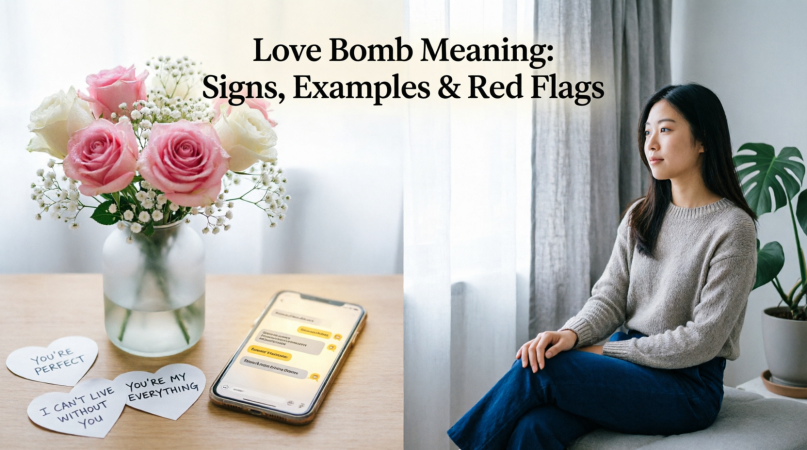
The term love bomb meaning describes an intense display of affection, attention, compliments, gifts, or romantic promises, often used to influence or control another person. Although affection can be genuine, love bombing becomes concerning when overwhelming attention is used to create emotional dependence, pressure someone into commitment, or manipulate their decisions.
Love Bomb Meaning & Definition
The love bomb meaning refers to showering someone with excessive affection, attention, praise, gifts, or declarations of love, especially during the early stages of a romantic relationship. The behavior may feel exciting and flattering at first, but it can become unhealthy when it is intended to gain control, rush intimacy, or make another person feel emotionally dependent.
For example, imagine meeting someone online who starts calling you their soulmate after two days, sends dozens of messages every hour, buys expensive gifts, and talks about marriage before you have had time to know each other. These actions might seem romantic, but the speed and intensity could be signs of love bombing, particularly if the person becomes angry when you ask to slow things down.
Love bombing is not simply about receiving compliments or experiencing an exciting new romance. The important difference is the pattern of behavior, the pressure involved, and whether the other person respects your boundaries.
Common signs associated with love bombing include:
- Giving excessive compliments early in a relationship.
- Making dramatic promises about marriage or a future together.
- Expecting constant communication and immediate replies.
- Buying expensive gifts that create a sense of obligation.
- Pressuring someone to commit before they feel ready.
- Becoming upset when the other person needs personal space.
- Using affection to influence decisions or avoid accountability.
In simple words: Love bombing is when affection becomes overwhelming or is used as a tool to influence someone rather than allowing a relationship to develop naturally.
Introduction
Falling in love can be exciting. A new partner may send sweet messages, remember little details, offer thoughtful gifts, and make you feel appreciated. These experiences can help two people develop trust and emotional closeness.
However, not every intense romantic beginning is healthy. Sometimes, affection arrives so quickly and in such overwhelming amounts that a person feels swept into a relationship before having enough time to understand the other person’s character.
This is where the concept of love bombing becomes important.
The phrase is commonly used in conversations about dating, relationship psychology, emotional manipulation, and unhealthy relationship patterns. It describes behavior that may initially look like extraordinary devotion but can sometimes be part of a broader pattern of control.
For example, a person might say, “I’ve never felt this way about anyone before,” after knowing someone for only a few days. That statement alone does not prove manipulation. But if it is accompanied by constant pressure, possessiveness, guilt, and demands for commitment, the situation deserves closer attention.
Understanding the term helps people distinguish between healthy enthusiasm and affection that ignores personal boundaries.
It is also important not to label every affectionate partner as manipulative. People express love differently, and some relationships naturally develop quickly. What matters most is whether affection is accompanied by respect, consistency, honesty, and freedom to make personal choices.
Origin of the Term Love Bomb
The expression love bombing has a history that predates its widespread use in modern dating discussions.
The term became associated with discussions of high-control groups and psychological influence during the 1970s. It was used to describe overwhelming attention, friendliness, praise, and a sense of belonging directed toward newcomers, sometimes to encourage loyalty to a group or its leadership.
Over time, the expression expanded beyond group settings. Relationship writers, therapists, and discussions about emotional abuse increasingly used it to describe intense romantic attention that may be intended to establish influence over a partner.
Today, the term appears in discussions about dating apps, romantic relationships, narcissistic behavior, emotional boundaries, and relationship red flags.
Although love bombing is frequently discussed alongside narcissism, it is important to understand that the behavior does not automatically establish a personality disorder. A person can behave manipulatively for different reasons, and only a qualified professional can assess a mental health condition.
The modern meaning therefore focuses less on how much affection someone expresses and more on how that affection functions within a relationship.
Why Is Love Bombing So Popular?
The expression has become widely recognized because it describes an experience that can be difficult to explain: receiving so much affection that it feels wonderful at first but eventually becomes uncomfortable or controlling.
Several factors have contributed to its popularity.
1. Online Dating Moves Quickly
Dating apps and social media make it easy to communicate frequently with someone new. Two people can exchange hundreds of messages, share personal stories, and develop a sense of closeness before meeting in person.
This can create genuine intimacy, but it can also make it easier for someone to rush emotional attachment.
2. Romantic Content Influences Expectations
Movies, songs, and social media often celebrate grand gestures, intense attraction, and declarations of everlasting love. While these experiences can be meaningful, they may also encourage people to interpret overwhelming attention as proof of a perfect relationship.
In reality, healthy love does not have to be dramatic to be genuine.
3. People Are Learning About Relationship Boundaries
More people are discussing emotional manipulation, consent, attachment, and healthy communication. The phrase provides a convenient way to describe certain troubling relationship patterns.
It also encourages people to ask whether they feel respected and comfortable rather than judging a relationship only by its romantic intensity.
4. Social Media Spreads Relationship Terminology
Videos, personal stories, podcasts, and relationship advice posts frequently discuss love bombing. This exposure has made the expression familiar to people who may previously have described the behavior simply as being overly romantic or possessive.
However, social media explanations can oversimplify the topic. A dramatic first date or frequent texting is not enough to establish that someone is love bombing.
How Is Love Bomb Used?

The phrase appears in conversations about romantic relationships, friendships, family dynamics, and other situations involving excessive affection or attention.
Its meaning depends on the context in which it is used.
In Romantic Relationships
This is the most common modern use of the expression.
Example: “He kept promising we would get married after our first week together. Looking back, I think he was love bombing me.”
The speaker is suggesting that the partner’s intense affection and premature promises may have been part of an unhealthy relationship pattern.
In Text Messages and Online Dating
People may use the term when describing someone who sends constant messages, gives excessive compliments, or expects immediate emotional commitment.
Example: “We’ve only been talking for three days, but she’s already planning our entire future. Is that love bombing?”
Here, the speaker is questioning whether the relationship is progressing too quickly.
In Friendships
Although the term is most commonly associated with romantic relationships, people sometimes use it to describe a new friend who offers overwhelming attention or praise and later uses that closeness to demand favors or loyalty.
The behavior matters more than the relationship label.
In Social Media Discussions
The phrase often appears in posts about relationship red flags, emotional manipulation, and dating experiences.
Example: “Don’t confuse constant attention with genuine respect. Learn the difference between affection and love bombing.”
This usage is generally educational or cautionary.
Love Bomb Examples
The following examples demonstrate how the phrase can be used naturally in different situations.
Friendly Examples
These examples use conversational language to describe potentially overwhelming romantic attention.
Example 1:
“My new boyfriend keeps sending me gifts every day. My friend thinks he might be love bombing me.”
Context: The speaker is discussing a concern raised by a friend. The gifts alone do not prove manipulation.
Example 2:
“She told me I was her soulmate after our second date. It felt romantic, but I wondered if it was love bombing.”
Context: The speaker is uncertain whether the intensity is healthy or premature.
Example 3:
“I like him, but I don’t want to rush things just because he’s giving me so much attention.”
Context: This is a gentle way to express a boundary without accusing the other person of manipulation.
Example 4:
“My cousin said to watch for love bombing because my date keeps making huge promises without knowing me well.”
Context: The phrase is used as relationship advice.
Professional Examples
In professional, counseling, or educational contexts, the term is often explained in more measured language.
Example 1:
“Love bombing may involve excessive affection and premature commitments that place pressure on a new partner.”
Context: An educational explanation of relationship behavior.
Example 2:
“The counselor encouraged the client to evaluate whether the partner respected personal boundaries rather than focusing solely on romantic gestures.”
Context: A neutral description that avoids diagnosing the partner.
Example 3:
“An early pattern of intense attention followed by controlling behavior may warrant closer examination.”
Context: This wording is appropriate for formal discussions because it describes observable behavior rather than assuming someone’s intentions.
Example 4:
“Relationship education can help people distinguish between healthy expressions of affection and behavior that creates emotional pressure.”
Context: A professional discussion about healthy relationships.
Funny Examples
The phrase can also appear in humorous conversations, although jokes should not minimize genuine experiences of emotional manipulation.
Example 1:
“He planned our wedding, named our future dog, and picked our retirement home before the coffee arrived. Someone needs to explain the difference between dating and love bombing!”
Example 2:
“Three dates in, and she has already created a shared calendar for our future vacations. Romantic enthusiasm or a relationship speedrun?”
Example 3:
“My phone received more love messages in one afternoon than it received software updates all year.”
Context: These jokes exaggerate intense attention for entertainment. The behavior becomes concerning when it involves pressure, fear, or disregard for boundaries.
Examples of Love Bombing in Sentences
| Sentence | Tone | Meaning |
|---|---|---|
| “He keeps saying I’m the only person who understands him.” | Concerned | The speaker notices unusually intense emotional dependence. |
| “She bought me expensive gifts before our first week was over.” | Neutral | The speaker describes a potentially overwhelming gesture. |
| “I felt pressured to say ‘I love you’ before I was ready.” | Serious | The speaker describes pressure to reciprocate feelings. |
| “He called me his soulmate after one conversation!” | Surprised | The speaker highlights premature emotional intensity. |
| “I asked for space, and he accused me of not caring.” | Concerned | The speaker describes a possible boundary violation. |
Comparison With Similar Terms
Love bombing is related to several other relationship expressions, but these terms are not interchangeable.
| Term | Meaning | Key Difference |
|---|---|---|
| Love bombing | Overwhelming affection that may be used to influence or control someone | Focuses on intensity and a potentially manipulative pattern |
| Genuine affection | Sincere expressions of care, love, or appreciation | Respects the other person’s comfort and boundaries |
| Infatuation | Intense attraction or fascination with someone | Can be emotionally intense without being deliberately manipulative |
| Honeymoon phase | An early relationship period characterized by excitement and affection | Usually describes a stage of a relationship, not manipulation |
| Flirting | Playful or romantic behavior that signals attraction | Does not necessarily involve emotional commitment or control |
| Idealization | Viewing someone as exceptionally perfect or overlooking their flaws | Can occur with or without deliberate manipulation |
| Emotional manipulation | Influencing another person’s feelings or choices through unhealthy tactics | A broader concept that can include love bombing |
| Gaslighting | A pattern of manipulating someone into doubting their perceptions or understanding of events | Focuses on undermining a person’s sense of reality |
| Breadcrumbing | Giving occasional attention or romantic signals without meaningful commitment | Often involves inconsistent, minimal attention rather than overwhelming affection |
| Future faking | Making promises about a shared future without a genuine intention to fulfill them | Focuses specifically on misleading promises |
Love Bombing vs. Genuine Love
The distinction between love bombing and genuine love is particularly important.
Genuine affection can be intense, generous, and exciting. A person might send thoughtful messages, arrange a special date, or express strong feelings early in a relationship without intending to manipulate anyone.
Healthy affection generally allows both people to move at a comfortable pace. Each person can say no, request space, maintain friendships, and make independent decisions without being punished emotionally.
Love bombing becomes more concerning when the affection is accompanied by pressure, possessiveness, guilt, or an expectation that the recipient must respond in a particular way.
A useful question is: What happens when you set a reasonable boundary?
If the person listens, respects your choice, and adjusts their behavior, that is a positive sign. If they become hostile, threaten to leave, demand reassurance, or make you feel guilty for needing space, the pattern deserves attention.
Love Bombing vs. the Honeymoon Phase
The honeymoon phase describes the excitement and strong attraction that often accompany a new relationship. Partners may communicate frequently, enjoy spending time together, and feel eager to learn about each other.
Love bombing, by contrast, refers to an interaction pattern in which excessive affection may be used to create influence or dependence.
The difference is not necessarily the number of messages or gifts. It is whether the behavior remains respectful and whether both people can make choices freely.
Alternate Meanings of Love Bomb

The expression has a broader history, so its meaning can change depending on the setting.
1. Psychological and Relationship Meaning
In modern relationship discussions, love bombing refers to overwhelming displays of affection that may be intended to gain influence over another person.
This is the meaning most commonly encountered in dating advice and discussions of emotional manipulation.
2. Group Influence and Cult-Related Meaning
Historically, the expression has also described intense friendliness, praise, and acceptance directed toward newcomers in certain high-control groups.
The purpose may be to create a powerful sense of belonging and encourage loyalty. However, not every welcoming community or enthusiastic group is engaging in manipulation.
3. Casual or Exaggerated Usage
In everyday conversation, someone might jokingly say they are being love bombed because a new admirer sends many compliments or messages.
In these situations, the speaker may be exaggerating for humor rather than making a serious claim about emotional abuse.
Understanding the surrounding context helps determine whether the expression is being used seriously, casually, or historically.
Professional or Polite Alternatives
Sometimes, the expression love bomb may sound accusatory, particularly when discussing an unfamiliar person or describing a situation in a professional setting.
More neutral alternatives can help communicate concerns without assuming intent.
| Alternative Phrase | Best Used When | Example |
|---|---|---|
| Excessive affection | Describing unusually intense displays of care | “The relationship began with excessive affection.” |
| Overwhelming attention | Discussing frequent messages, calls, or gestures | “I found the overwhelming attention difficult to manage.” |
| Rushed emotional intimacy | Describing closeness that develops unusually quickly | “I felt uncomfortable with the rushed emotional intimacy.” |
| Premature commitment | Referring to early promises about a serious relationship | “The repeated requests for commitment felt premature.” |
| Boundary-crossing behavior | Explaining conduct that disregards personal limits | “I am concerned about the boundary-crossing behavior.” |
| Emotionally pressuring behavior | Describing attempts to influence someone’s feelings or decisions | “I do not want to participate in emotionally pressuring behavior.” |
| Intense romantic pursuit | Describing persistent or unusually strong romantic interest | “The intense romantic pursuit made me want to slow things down.” |
| Manipulative displays of affection | Discussing affection that appears connected to control | “The pattern may involve manipulative displays of affection.” |
How to Express Your Concerns Politely
If someone is giving you more attention than you are comfortable with, you do not need to accuse them of love bombing.
You can communicate your feelings directly:
- “I appreciate your interest, but I would prefer to take things slowly.”
- “I need some personal space, and I hope you can respect that.”
- “I enjoy getting to know you, but I am not ready to make long-term commitments.”
- “I feel uncomfortable when I am expected to reply immediately.”
- “I would like our relationship to develop naturally without pressure.”
These statements focus on your boundaries rather than trying to determine the other person’s motives.
Common Mistakes When Understanding Love Bombing
Several misunderstandings can make the term confusing or lead people to apply it incorrectly.
Mistake 1: Assuming Every Romantic Gesture Is Love Bombing
Buying flowers, planning a thoughtful date, or expressing affection does not automatically indicate manipulation.
Better approach: Consider the wider pattern and whether the person respects your boundaries.
Mistake 2: Confusing Fast Attraction With Deliberate Control
Some people develop strong feelings quickly. Intense attraction alone does not prove that someone has an ulterior motive.
Better approach: Look at how the relationship develops over time and how the person responds when you disagree or slow things down.
Mistake 3: Treating Love Bombing as a Mental Health Diagnosis
The term describes a behavior pattern, not a formal diagnosis. It cannot establish that someone is a narcissist or has a particular personality disorder.
Better approach: Describe specific actions instead of assigning a diagnosis.
Mistake 4: Ignoring What Happens After You Set Boundaries
Excessive affection may be less informative than the response you receive when you express discomfort.
Better approach: Pay attention to whether your needs are respected or met with guilt, anger, threats, or persistent pressure.
Mistake 5: Assuming Love Bombing Always Leads to Abuse
Love bombing is associated with some unhealthy or abusive relationship patterns, but every intense beginning does not inevitably lead to abuse.
Better approach: Evaluate the actual behavior and its effects instead of predicting the future from one incident.
Mistake 6: Using the Term as an Insult
Calling someone a love bomber without explaining the behavior can turn a useful concept into a personal accusation.
Better approach: Use specific descriptions such as “repeatedly pressuring me to commit” or “ignoring my request for space.”
Quick Tips for Recognizing and Responding to Love Bombing

Understanding the concept is useful, but knowing how to respond can be even more valuable.
- Take your time. You do not have to match another person’s emotional intensity or agree to commitment before you feel ready.
- Maintain your independence. Continue spending time with friends, pursuing hobbies, and making decisions about your own life.
- Notice repeated patterns. One grand gesture does not tell you everything. Look for ongoing pressure, possessiveness, or disregard for your choices.
- Set clear boundaries. Explain what feels comfortable to you and observe whether the person respects those limits.
- Look for consistency. Healthy relationships generally involve care and respect beyond the initial excitement.
- Trust your discomfort. You do not need definitive proof of manipulation to decide that a relationship is moving too quickly for you.
- Seek outside perspective. Talking to a trusted friend, counselor, or qualified relationship professional can help you assess a confusing situation.
- Prioritize safety. If the behavior involves threats, stalking, coercion, or fear, consider reaching out to trusted support services and making a safety plan.
Remember that you cannot reliably determine someone’s intentions from romantic words alone. You can, however, evaluate their actions, their response to boundaries, and how the relationship affects your well-being.
FAQS
1. What does love bomb mean in simple words?
Love bomb means giving someone an overwhelming amount of affection, attention, compliments, gifts, or romantic promises. In relationship discussions, the term often describes affection that may be used to influence or control another person.
2. What does love bombing mean in a relationship?
Love bombing in a relationship refers to intense romantic attention that may create pressure, emotional dependence, or a rushed sense of commitment. It can include constant messages, expensive gifts, premature declarations of love, and difficulty accepting personal boundaries.
3. What are the signs of love bombing?
Common signs include excessive compliments, rapid declarations of love, pressure to commit, constant communication demands, possessiveness, and guilt when you request space. The overall pattern matters more than any single behavior.
4. Is love bombing always bad?
Intense affection is not automatically harmful. Some people genuinely express strong feelings early in a relationship. It becomes concerning when affection is connected to pressure, manipulation, control, or disregard for another person’s boundaries.
5. What is the difference between love bombing and genuine love?
Genuine love allows affection and commitment to develop while respecting both people’s needs, choices, and boundaries. Love bombing describes overwhelming affection that may be used to rush intimacy or gain influence over another person.
6. How long does love bombing last?
There is no fixed duration. In some unhealthy relationships, intense attention may decrease after commitment or once the other person becomes emotionally invested. In other situations, the behavior may continue or change over time. Duration alone cannot determine whether love bombing is occurring.
7. Can love bombing happen over text?
Yes. Love bombing can involve frequent messages, constant declarations of love, excessive digital gifts, demands for immediate replies, or pressure to remain available online. However, frequent texting by itself is not enough to identify manipulation.
8. What should you do if someone is love bombing you?
Take time to assess the situation, establish boundaries, and avoid making commitments under pressure. Talk with someone you trust if you feel confused or uncomfortable. If the person responds with threats, intimidation, stalking, or coercion, prioritize your safety and seek appropriate support.
Conclusion
Understanding the love bomb meaning helps you recognize the difference between intense romantic attention and a potentially unhealthy relationship pattern. The phrase describes overwhelming affection, compliments, gifts, or promises that may be used to rush intimacy, create emotional dependence, or influence another person’s choices.
However, affection alone is not proof of manipulation. A relationship should be evaluated through consistent behavior, honest communication, mutual respect, and the way both people respond to boundaries.
If someone expresses strong feelings for you, you can appreciate their interest without feeling obligated to move faster than you want. Healthy relationships allow both people to develop trust naturally, maintain their independence, and communicate openly.
Ultimately, the most useful question is not simply how much affection someone gives you. It is whether that affection makes room for your comfort, freedom, and well-being. Genuine care does not require you to abandon your boundaries to prove that you care in return.