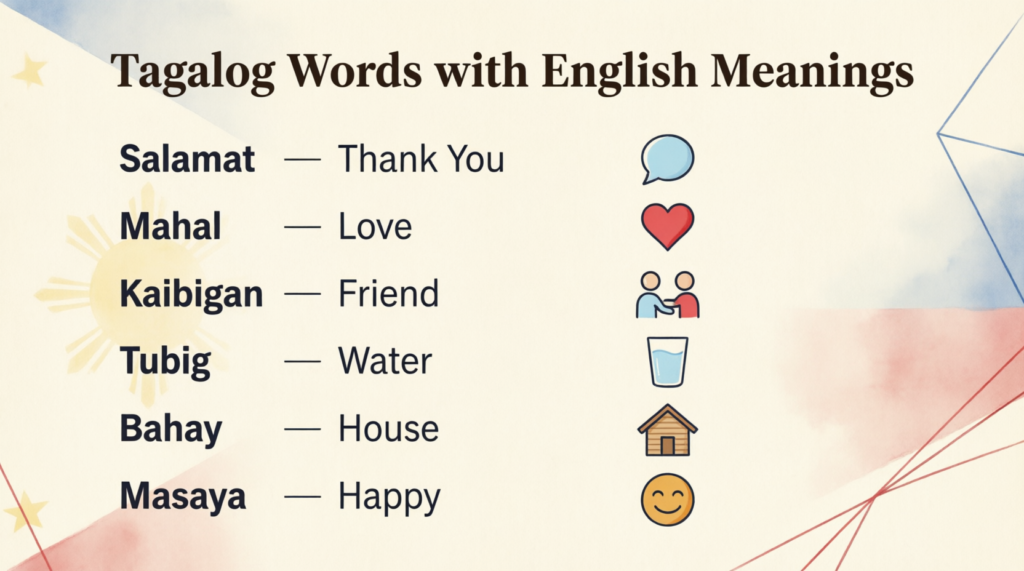
Tagalog in English words with meaning refers to Tagalog words translated into English, helping learners understand Filipino vocabulary, everyday expressions, greetings, emotions, and common phrases. Examples include salamat (thank you), mahal (love or expensive, depending on context), kaibigan (friend), and tubig (water).
Tagalog in English Words With Meaning: Definition
Tagalog is one of the major languages spoken in the Philippines and serves as the primary linguistic foundation of Filipino, the country’s national language. Learning Tagalog words with their English meanings makes it easier to communicate with Filipino speakers, understand conversations, and explore Filipino culture.
Many Tagalog words have straightforward English translations. For example, bahay means house, pagkain means food, and araw can mean sun or day, depending on the sentence.
However, some words have several meanings, and their translations can change according to context, tone, and usage. The word mahal, for instance, can mean love or beloved when used affectionately, but it can also mean expensive when describing a product.
Here are some common Tagalog words and their English meanings:
| Tagalog word | English meaning |
|---|---|
| Salamat | Thank you |
| Oo | Yes |
| Hindi | No or not |
| Kumusta | How are you? |
| Mahal | Love, beloved, or expensive |
| Kaibigan | Friend |
| Pamilya | Family |
| Bahay | House or home |
| Tubig | Water |
| Pagkain | Food |
| Masaya | Happy |
| Malungkot | Sad |
| Maganda | Beautiful |
| Mabait | Kind or good |
| Paalam | Goodbye |
These basic translations are useful starting points for students, travelers, language enthusiasts, and anyone interested in communicating with Filipino friends or family.
Introduction
Learning a new language can open doors to friendships, cultural experiences, and meaningful conversations. Tagalog is an excellent language to explore if you want to understand Filipino expressions, appreciate local traditions, or communicate more comfortably with people from the Philippines.
You might hear someone say salamat po when expressing gratitude, kumusta ka? when asking how you are, or ingat ka when wishing someone to stay safe. These expressions are more than vocabulary items; they reflect everyday Filipino communication and social courtesy.
For English speakers, learning Tagalog becomes easier when words are organized into practical categories. Greetings, family terms, food vocabulary, emotions, and everyday expressions provide a useful foundation before moving on to longer sentences.
This guide covers more than 100 Tagalog words and expressions with English meanings, examples, pronunciation tips, and explanations of how context affects translation. It also explores common mistakes and provides practical advice for using Filipino vocabulary naturally.
Whether you are a beginner, a traveler planning a visit to the Philippines, or someone hoping to connect with Filipino friends, these words will help you take your first steps toward understanding the language.
Origin of Tagalog and Its Connection to Filipino
Tagalog belongs to the Austronesian language family, a large family of languages spoken across Southeast Asia and the Pacific. It developed in the Philippines and has historically been spoken in areas including Manila and parts of Luzon.
Over time, Tagalog incorporated vocabulary from several languages through trade, migration, colonization, and cultural exchange. Spanish contributed many words, while English has had a significant influence on modern Filipino vocabulary. Other linguistic influences include Chinese languages and neighboring Philippine languages.
Filipino, the national language of the Philippines, is based primarily on Tagalog and continues to develop through contact with other Philippine languages and modern usage.
Although the terms Tagalog and Filipino are often used interchangeably in casual conversation, they are not exactly identical in every linguistic context. Tagalog refers to a particular language, while Filipino is the standardized national language that draws heavily on Tagalog and accommodates broader linguistic influences.
Read This 444 Tattoo Meaning: Symbolism, Spiritual Signs, and Powerful Design Ideas
Why Do Some Tagalog Words Sound Familiar?

Some Tagalog words resemble Spanish or English words because of historical contact.
Examples include:
| Tagalog word | English meaning | Linguistic note |
|---|---|---|
| Mesa | Table | From Spanish mesa |
| Silya | Chair | Related to Spanish silla |
| Bintana | Window | From Spanish ventana |
| Sapatos | Shoes | From Spanish zapatos |
| Libro | Book | From Spanish libro |
| Telepono | Telephone | Related to the international word for telephone |
| Kompyuter | Computer | Adapted from English computer |
These similarities can help learners remember vocabulary. However, pronunciation and usage may differ, so it is still useful to learn each word as it is spoken in Filipino conversations.
Popularity of Tagalog Words and Expressions
Tagalog vocabulary is widely encountered in everyday life in the Philippines, in Filipino communities abroad, and across social media. Filipino films, television programs, music, online videos, and family conversations introduce learners to commonly used words.
Many people also search for Tagalog translations to communicate with partners, relatives, coworkers, classmates, and friends.
Why People Learn Tagalog
1. Communicating with Filipino friends and family
Learning expressions such as kumusta, salamat, and mahal kita can make everyday conversations more personal.
2. Traveling in the Philippines
Basic words for food, directions, transportation, and shopping can help travelers navigate daily situations.
3. Understanding Filipino culture
Language provides insight into values such as hospitality, respect for elders, family relationships, and community.
4. Learning through entertainment
Filipino songs, movies, and social media often feature familiar expressions that learners can practice in context.
5. Building professional relationships
People working with Filipino colleagues or customers may benefit from understanding greetings and polite expressions.
Respectful language is particularly important. Words such as po and opo can communicate courtesy, especially when speaking with elders or people in formal situations.
How Tagalog Words Are Used in Everyday Life
Tagalog words appear in greetings, questions, family conversations, shopping, food orders, and emotional expressions. Some words work independently, while others need to be combined with additional words to create a complete sentence.
The following categories provide a practical vocabulary guide.
Common Tagalog Greetings and Basic Words
| Tagalog word or phrase | English meaning |
|---|---|
| Kumusta? | How are you? |
| Magandang umaga | Good morning |
| Magandang hapon | Good afternoon |
| Magandang gabi | Good evening |
| Oo | Yes |
| Hindi | No or not |
| Sige | Okay, sure, or go ahead |
| Salamat | Thank you |
| Maraming salamat | Thank you very much |
| Walang anuman | You’re welcome |
| Paalam | Goodbye |
| Sandali | Wait a moment |
| Pasensya na | Sorry |
| Pakiusap | Please or a request, depending on context |
| Oo naman | Of course |
| Hindi ko alam | I don’t know |
| Naiintindihan ko | I understand |
| Hindi ko maintindihan | I don’t understand |
| Ano? | What? |
| Bakit? | Why? |
Example: If someone helps you carry a bag, you can say, “Maraming salamat!” to express sincere gratitude.
Tagalog Words for Family and Relationships
Family relationships are important in Filipino culture, and many Tagalog terms reflect different relationships within a household.
| Tagalog word | English meaning |
|---|---|
| Pamilya | Family |
| Nanay | Mother |
| Tatay | Father |
| Ina | Mother, often more formal or literary |
| Ama | Father, often more formal or literary |
| Ate | Older sister or respectful term for an older female |
| Kuya | Older brother or respectful term for an older male |
| Kapatid | Sibling |
| Anak | Child or offspring |
| Asawa | Spouse |
| Lolo | Grandfather |
| Lola | Grandmother |
| Tita | Aunt or familiar term for an older woman |
| Tito | Uncle or familiar term for an older man |
| Kaibigan | Friend |
| Kasintahan | Romantic partner or sweetheart |
| Mahal | Beloved or dear |
| Kaaway | Enemy |
| Kapitbahay | Neighbor |
| Kaklase | Classmate |
Example: “Siya ang aking kaibigan” means “That person is my friend.”
Tagalog Words for Food and Drinks
Food vocabulary is especially useful when visiting Filipino restaurants, shopping at markets, or sharing meals with Filipino friends.
| Tagalog word | English meaning |
|---|---|
| Pagkain | Food |
| Tubig | Water |
| Kanin | Cooked rice |
| Bigas | Uncooked rice |
| Tinapay | Bread |
| Gatas | Milk |
| Kape | Coffee |
| Tsaa | Tea |
| Isda | Fish |
| Karne | Meat |
| Manok | Chicken |
| Baboy | Pork |
| Gulay | Vegetables |
| Prutas | Fruit |
| Itlog | Egg |
| Asukal | Sugar |
| Asin | Salt |
| Sabaw | Soup or broth |
| Masarap | Delicious |
| Gutom | Hunger |
| Uhaw | Thirst |
Example: “Gusto ko ng tubig” means “I want water.”
A useful distinction is kanin versus bigas. Both refer to rice, but kanin is cooked rice, while bigas refers to uncooked rice grains.
Read This Lotus Flower Tattoo Meaning: Symbolism, Spiritual Growth, and New Beginnings
Tagalog Words for Emotions and Feelings
Emotional vocabulary helps learners describe how they feel and understand what other people are experiencing.
| Tagalog word | English meaning |
|---|---|
| Masaya | Happy |
| Malungkot | Sad |
| Galit | Angry |
| Takot | Afraid |
| Pagod | Tired |
| Kilig | A feeling of romantic excitement or butterflies |
| Saya | Happiness or joy |
| Lungkot | Sadness |
| Pag-ibig | Love |
| Saya | Joy or happiness, depending on context |
| Inis | Annoyance |
| Gulat | Surprise |
| Hiya | Shame, embarrassment, or a sense of social propriety |
| Pag-asa | Hope |
| Pangamba | Worry or apprehension |
| Kalungkutan | Sadness |
| Saya ko | My happiness, depending on context |
| Mahal kita | I love you |
| Miss kita | I miss you; common conversational usage |
| Ayos lang | It’s okay or I’m fine |
Example: “Masaya ako ngayon” means “I am happy today.”
The word kilig is particularly interesting because it describes a feeling often associated with romantic excitement, such as getting butterflies when someone you like sends you a sweet message.
Tagalog Words for Everyday Objects and Places

| Tagalog word | English meaning |
|---|---|
| Bahay | House or home |
| Paaralan | School |
| Silid | Room |
| Pinto | Door |
| Bintana | Window |
| Mesa | Table |
| Silya | Chair |
| Kama | Bed |
| Damit | Clothes |
| Sapatos | Shoes |
| Bag | Bag |
| Libro | Book |
| Lapis | Pencil |
| Papel | Paper |
| Telepono | Telephone |
| Kompyuter | Computer |
| Kotse | Car |
| Kalsada | Road |
| Tindahan | Shop or store |
| Ospital | Hospital |
Example: “Nasaan ang libro?” means “Where is the book?”
Tagalog Words for Time, Nature, and Weather
| Tagalog word | English meaning |
|---|---|
| Araw | Sun or day |
| Gabi | Night |
| Umaga | Morning |
| Hapon | Afternoon |
| Bukas | Tomorrow or open, depending on context |
| Kahapon | Yesterday |
| Ngayon | Now or today |
| Linggo | Week or Sunday, depending on context |
| Buwan | Month or moon |
| Taon | Year |
| Tubig | Water |
| Ulan | Rain |
| Hangin | Wind or air |
| Araw-araw | Every day |
| Ulap | Cloud |
| Langit | Sky or heaven |
| Lupa | Land, soil, or earth |
| Dagat | Sea |
| Bundok | Mountain |
| Puno | Tree or full, depending on context |
These words are useful for discussing plans, weather, the natural world, and daily routines.
Examples of Tagalog Words in Sentences
Learning individual translations is helpful, but using words in complete sentences makes them easier to remember.
Friendly Examples
1. Kumusta ka?
English: How are you?
Usage: A common greeting for friends, relatives, and acquaintances.
2. Salamat sa tulong mo.
English: Thank you for your help.
Usage: A friendly way to express gratitude.
3. Ingat ka!
English: Take care!
Usage: A warm expression used when someone is leaving or traveling.
4. Mahal kita.
English: I love you.
Usage: An affectionate expression used with a romantic partner or someone you love.
5. Ang ganda!
English: How beautiful!
Usage: An informal expression of admiration.
6. Masarap ang pagkain.
English: The food is delicious.
Usage: A compliment after eating a meal.
Professional Examples
Tagalog can also be useful in workplace conversations, customer service, and formal interactions. Adding respectful language can make requests sound more courteous.
1. Magandang umaga po.
English: Good morning.
Usage: A polite greeting for customers, supervisors, or older colleagues.
2. Maaari po ba akong magtanong?
English: May I ask a question?
Usage: A respectful way to begin an inquiry.
3. Salamat po sa inyong tulong.
English: Thank you for your help.
Usage: A courteous expression of appreciation.
4. Pasensya na po sa abala.
English: Sorry for the inconvenience.
Usage: A polite apology when interrupting someone or causing inconvenience.
5. Pakisabi na lamang po kung may kailangan pa.
English: Please let me know if anything else is needed.
Usage: A courteous expression in service or workplace communication.
The particle po generally adds politeness. It is particularly common when addressing elders or in respectful interactions, although appropriate usage varies by relationship and situation.
Funny Examples
Playful Tagalog expressions can help learners remember vocabulary, especially when chatting with friends.
1. Gutom na ako!
English: I’m hungry already!
Context: A funny way to announce that you are ready to eat.
2. Antok na antok ako.
English: I’m extremely sleepy.
Context: Useful after a long day or a late night.
3. Nasaan ang pagkain?
English: Where is the food?
Context: A playful question when everyone is waiting for a meal.
4. Wala akong pera!
English: I have no money!
Context: A common expression that can be humorous when discussing shopping or expensive plans.
5. Ang bilis ng oras!
English: Time flies!
Context: Useful when a fun gathering seems to end too quickly.
Tone depends on the relationship between speakers. A phrase that sounds funny among close friends may not be appropriate in a formal workplace conversation.
Comparison With Similar Terms and Language Concepts
Tagalog vocabulary can be easier to learn when you understand how related words differ. Some words have similar translations but are used in different contexts.
| Tagalog word | Related word | Difference |
|---|---|---|
| Mahal | Pag-ibig | Mahal can mean beloved, love, or expensive; pag-ibig is a noun meaning love |
| Bahay | Tahanan | Both can mean home; tahanan often emphasizes the home as a place of belonging |
| Kaibigan | Kakilala | A friend versus an acquaintance |
| Kanin | Bigas | Cooked rice versus uncooked rice |
| Masaya | Saya | Masaya commonly means happy; saya can mean happiness or joy |
| Araw | Umaga | Sun or day versus morning |
| Oo | Opo | Yes versus a more respectful form of yes |
| Hindi | Huwag | No/not versus don’t, used to express prohibition |
| Salamat | Pasasalamat | Thank you versus gratitude or the act of giving thanks |
| Maganda | Mabuti | Beautiful or good-looking versus good, beneficial, or morally good |
Tagalog, Filipino, and English: What Is the Difference?
Tagalog is a specific Philippine language with its own vocabulary and grammatical structure.
Filipino is the national language of the Philippines, based primarily on Tagalog while continuing to develop through contact with other Philippine languages.
English is also an official language of the Philippines and is widely used in education, government, business, and other settings.
Many Filipino speakers naturally mix Tagalog and English in everyday conversation. This practice is commonly called Taglish.
For example, “Mag-meeting tayo bukas” means “Let’s have a meeting tomorrow.” It combines Tagalog sentence structure with the English word “meeting” adapted into conversational Filipino.
Code-switching is a normal feature of many multilingual communities. However, learners should understand the basic Tagalog words first before relying on mixed-language expressions.
Alternate Meanings of Common Tagalog Words
Some Tagalog words have multiple meanings. Their correct translations often become clear only when you understand the sentence.
| Word | Possible English meanings | Example or context |
|---|---|---|
| Mahal | Love, beloved, expensive | Mahal ang bag = The bag is expensive |
| Araw | Sun, day | Mainit ang araw = The sun is hot |
| Bukas | Tomorrow, open | Bukas ang pinto = The door is open |
| Buwan | Moon, month | The context determines which meaning applies |
| Puno | Tree, full | Puno ang baso = The glass is full |
| Hapon | Afternoon, Japanese person | Capitalization and sentence context may help distinguish meanings |
| Sakit | Pain, illness | The sentence determines whether it means physical pain or sickness |
| Galing | Skill, ability, from a place | Context determines the intended meaning |
| Tingin | Look, glance, opinion | It can refer to looking or a person’s view |
| Tama | Correct, right, hit | Meaning depends on how it is used |
For example, bukas means tomorrow in “Bukas ako aalis” (I will leave tomorrow). In “Bukas ang tindahan,” it means the store is open.
These examples demonstrate why translating words individually does not always produce an accurate sentence.
Professional or Polite Alternatives in Tagalog
Some expressions are more suitable for formal situations, while others work best among close friends.

| Casual expression | Polite or formal alternative | English meaning |
|---|---|---|
| Salamat | Salamat po | Thank you |
| Oo | Opo | Yes |
| Ano? | Ano po iyon? | What was that? |
| Pahingi | Maaari po bang makahingi? | May I please have some? |
| Teka | Sandali lang po | Just a moment, please |
| Pasensya na | Pasensya na po | I’m sorry |
| Kumusta? | Kumusta po kayo? | How are you? |
| Puwede? | Maaari po ba? | Is it possible? |
| Pakisabi | Maaari po bang sabihin ninyo? | Could you please tell them? |
| Sige | Sige po | All right, respectfully |
Politeness depends on more than individual words. Your tone of voice, facial expressions, relationship with the listener, and the situation also influence how a statement is received.
When speaking to an older person or someone you do not know well, using po and opo can be a useful starting point. In casual conversations with close friends, simpler expressions may sound more natural.
Common Mistakes When Learning Tagalog Words
Beginners sometimes memorize translations without learning how the words work in sentences. Avoiding the following mistakes can improve both understanding and pronunciation.
1. Translating every word literally
A direct translation may sound unnatural in English. Learn complete expressions alongside individual vocabulary items.
2. Confusing similar words
For example, kanin means cooked rice, while bigas means uncooked rice. Learning the difference prevents confusion during conversations.
3. Ignoring context
Words such as mahal, bukas, and araw can have multiple meanings. Consider the complete sentence before selecting an English translation.
4. Using informal language in every situation
Expressions suitable for close friends may sound too casual in formal interactions. Learn polite forms such as salamat po and opo.
5. Assuming Tagalog and Filipino are completely interchangeable
They overlap considerably, but Filipino is the national language and has a broader standardized role. Recognizing this distinction provides useful linguistic context.
6. Forgetting pronunciation and stress
Tagalog pronunciation is relatively consistent, but stress can affect how some words sound and are understood. Listening to native speakers is more effective than relying exclusively on written spellings.
7. Memorizing too many words at once
Learning 10 useful words and using them in sentences is often more effective than memorizing 100 words without practice.
Quick Tips for Learning Tagalog With English Meanings
Use these practical techniques to build your vocabulary and remember what you learn.
- Start with everyday expressions. Learn greetings, thank-you phrases, common questions, and basic responses first.
- Group vocabulary by topic. Keep family words together, then study food, emotions, places, and time-related vocabulary.
- Practice complete sentences. Instead of memorizing only tubig (water), learn Gusto ko ng tubig (I want water).
- Listen to native speakers. Filipino films, interviews, music, and conversations can help you recognize natural pronunciation.
- Review regularly. Revisit words after a day, several days, and a week to strengthen recall.
- Practice polite expressions. Understand when to use po, opo, and other respectful forms.
- Keep a vocabulary notebook. Record the Tagalog word, its English meaning, an example sentence, and any alternate meanings.
- Learn through real situations. Practice ordering food, greeting someone, asking for directions, and introducing yourself.
- Use context to understand multiple meanings. A sentence provides clues that an isolated word cannot.
- Be patient with yourself. Consistent daily practice is more valuable than trying to become fluent overnight.
A simple daily routine could include learning five new words, reviewing ten older words, and creating three original sentences. With consistent practice, everyday Tagalog vocabulary becomes easier to recognize and use naturally.
FAQ: Tagalog in English Words With Meaning
1. What are some common Tagalog words with English meanings?
Common examples include salamat (thank you), oo (yes), hindi (no or not), bahay (house), tubig (water), kaibigan (friend), masaya (happy), and mahal (love, beloved, or expensive).
2. What does “mahal kita” mean in English?
Mahal kita means “I love you” in English. It is a common affectionate expression used with romantic partners and other loved ones. The word mahal can also mean expensive in other contexts.
3. What are basic Tagalog words for beginners?
Useful beginner words include oo (yes), hindi (no or not), salamat (thank you), kumusta (how are you), tubig (water), pagkain (food), bahay (house), and paalam (goodbye).
4. How do you say thank you in Tagalog?
You say salamat for “thank you.” For a more respectful expression, use salamat po. To say “thank you very much,” you can use maraming salamat.
5. What is the difference between Tagalog and Filipino?
Tagalog is a specific Philippine language, while Filipino is the national language of the Philippines and is based primarily on Tagalog. Filipino continues to develop through contact with other Philippine languages and modern vocabulary.
6. What are some romantic Tagalog words with English meanings?
Examples include mahal (beloved or love), mahal kita (I love you), kasintahan (romantic partner), pag-ibig (love), and kilig (romantic excitement or butterflies). The best choice depends on the situation and intended meaning.
7. What are polite Tagalog words to use with elders?
Common polite expressions include po, opo, salamat po (thank you), magandang umaga po (good morning), and pasensya na po (I’m sorry). These expressions can show respect, especially in conversations with elders or people you do not know well.
8. Is Tagalog easy to learn for English speakers?
Basic Tagalog vocabulary can be approachable for English speakers, particularly when learning everyday greetings and familiar expressions. However, grammar, verb forms, word order, and pronunciation require practice. Learning words in complete sentences helps build a stronger foundation.
9. What are some Tagalog words that have multiple meanings?
Examples include mahal (love or expensive), bukas (tomorrow or open), araw (sun or day), buwan (moon or month), and puno (tree or full). Their intended meanings depend on the context in which they appear.
10. How can I learn Tagalog words faster?
Start with common words, organize them into categories, practice short sentences, listen to native speakers, and review vocabulary regularly. Flashcards and short daily conversations can also help improve recall and confidence.
Conclusion
Learning Tagalog in English words with meaning is a practical way to begin understanding Filipino conversations and culture. From everyday greetings such as kumusta and salamat to affectionate expressions such as mahal kita, even a small vocabulary can make communication more meaningful.
Start with common words for family, food, emotions, places, and daily activities. Then practice using them in complete sentences and pay attention to context, pronunciation, and polite expressions.
Remember that some Tagalog words have multiple meanings, and their correct translations depend on how they are used. Understanding these differences will help you move beyond memorization and communicate more naturally.
With regular practice, patience, and a willingness to learn from native speakers, you can steadily improve your Tagalog vocabulary and develop a deeper appreciation for Filipino language and culture.