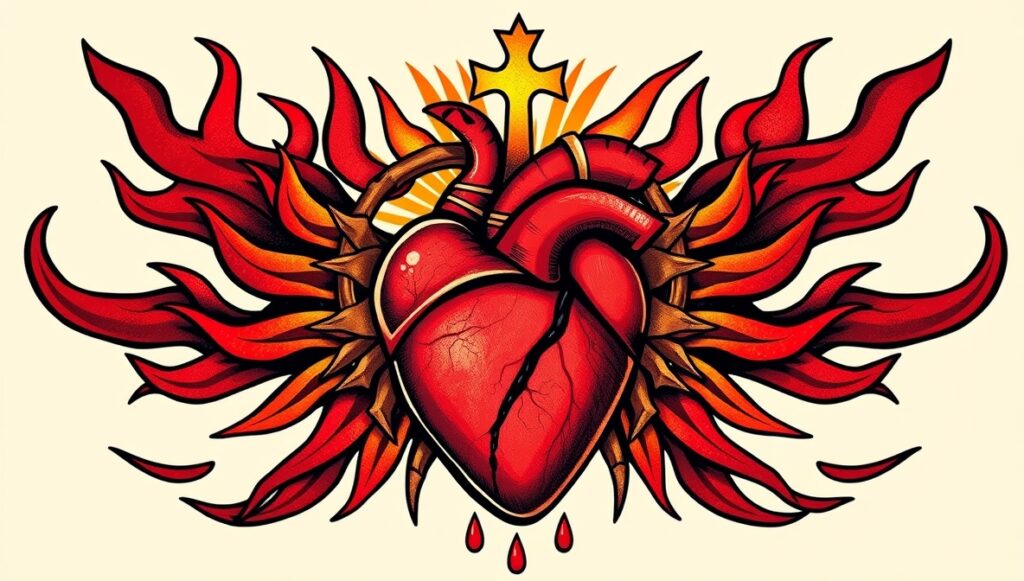
The sacred heart tattoo meaning is most commonly associated with divine love, Christian faith, compassion, sacrifice, emotional pain, and spiritual devotion. Often depicted as a heart surrounded by flames, wrapped in thorns, or pierced by a sword, this tattoo represents love that remains powerful even through suffering.
Sacred Heart Tattoo Meaning & Definition
A sacred heart tattoo is a meaningful design inspired by the Sacred Heart of Jesus in Christian tradition. It symbolizes unconditional love, mercy, sacrifice, forgiveness, and the emotional strength required to keep loving despite hardship.
The traditional design often features a human heart surrounded by flames, a crown of thorns, a cross, or a wound. Each element contributes to the tattoo’s symbolism, making it more than a decorative image.
Although the sacred heart has deep Christian roots, people may also choose this tattoo to express personal resilience, emotional vulnerability, devotion to loved ones, or the belief that love can survive suffering.
Here are the most common interpretations:
- Faith and devotion: A visible reminder of a person’s relationship with God or Jesus Christ.
- Unconditional love: The ability to love others with patience, kindness, and compassion.
- Sacrifice: Acknowledgment of the difficulties and sacrifices that sometimes accompany love.
- Healing and resilience: A symbol of overcoming emotional wounds while remaining open to love.
- Protection: A spiritual reminder of guidance, hope, and divine care.
- Forgiveness: A commitment to mercy, understanding, and second chances.
The meaning depends on the wearer’s beliefs, experiences, and chosen design. For one person, it may represent religious devotion; for another, it may symbolize a heart that has experienced pain but refuses to become cold.
Introduction
Some tattoos tell a story without requiring a single word. The sacred heart tattoo is one of them. With its dramatic flames, thorny crown, and often richly colored heart, this design combines powerful visual details with centuries of religious and artistic history.
Unlike a simple heart tattoo that usually represents romance or affection, the sacred heart carries a broader message. It connects love with sacrifice, faith with compassion, and suffering with the possibility of spiritual renewal.
Its appeal comes partly from this combination of beauty and complexity. The design can look traditional and devotional, bold and rebellious, or delicate and personal, depending on the artist’s approach.
For religious individuals, the sacred heart may serve as a permanent expression of Christian faith. For others, it represents the courage to remain compassionate after experiencing disappointment, grief, or heartbreak.
Understanding the sacred heart tattoo meaning requires looking at its religious origins, traditional imagery, modern interpretations, and the differences between this symbol and other heart tattoos.
Origin of the Sacred Heart Tattoo
The Sacred Heart symbol originates from Christian devotion to the heart of Jesus Christ. In Catholic tradition, the heart represents Christ’s love for humanity, his compassion, and his willingness to suffer for others.
Devotion to the Sacred Heart developed over many centuries. During the medieval period, Christian spirituality increasingly emphasized the humanity and emotional suffering of Jesus. Later, the religious experiences and writings associated with Saint Margaret Mary Alacoque in seventeenth-century France helped popularize devotion to the Sacred Heart.
The image eventually became widely recognizable through Catholic art, paintings, statues, prayer cards, jewelry, and religious objects.
Tattoo artists later adapted this established religious imagery into permanent body art. Traditional tattoo styles, particularly those influenced by bold outlines and vivid colors, helped make the sacred heart a recognizable tattoo design.
Read This Medusa Tattoo Meaning: Symbolism, Strength, Protection, and Healing
What Do the Traditional Elements Represent?
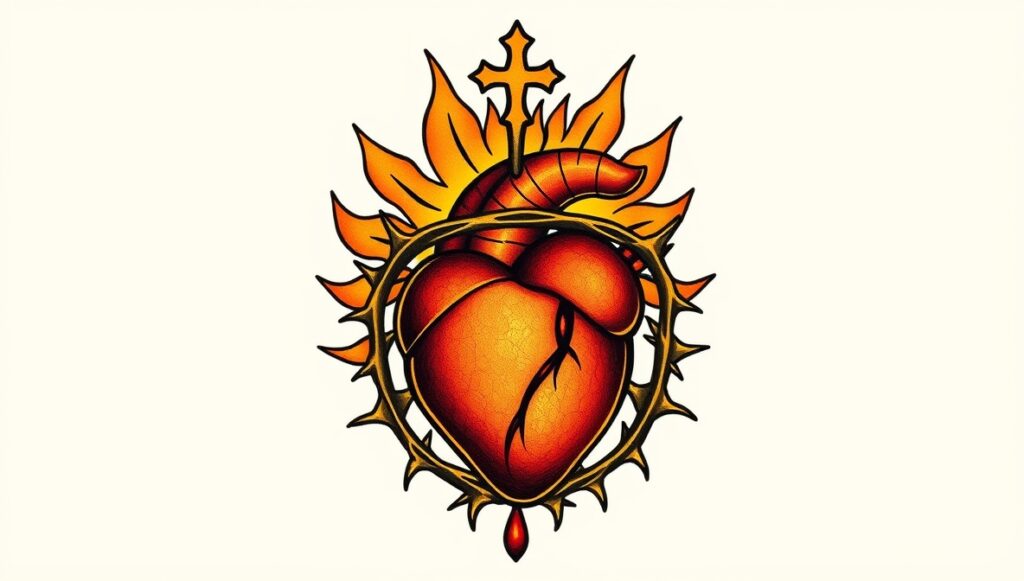
The sacred heart contains several visual elements, and each can communicate a different part of its meaning.
| Design element | Common symbolic meaning |
|---|---|
| Heart | Love, compassion, devotion, and emotional life |
| Flames | Divine love, spiritual passion, and transformative power |
| Crown of thorns | Suffering, sacrifice, and the Passion of Christ |
| Cross above the heart | Christian faith, salvation, and Christ’s sacrifice |
| Wound or blood | Pain, suffering, and love expressed through sacrifice |
| Rays of light | Divine grace, hope, and spiritual illumination |
| Roses or flowers | Love, beauty, devotion, and sometimes remembrance |
| Sword piercing the heart | Sorrow, grief, emotional pain, or sacrifice, depending on the design |
Not every sacred heart tattoo includes all these elements. A simplified outline may focus on the heart and flames, while a traditional religious composition may incorporate the thorns, cross, and wounds.
The wearer can also add personal details, such as a name, date, or flower, to connect the established symbol with an individual experience.
Popularity of Sacred Heart Tattoos
Sacred heart tattoos have remained recognizable because they combine religious symbolism with a distinctive visual style. Their bold shapes and expressive details work well in both traditional and contemporary tattoo designs.
The symbol is especially associated with traditional tattoo art, including designs featuring thick black outlines, red hearts, golden flames, and carefully illustrated thorns.
However, its popularity is not limited to one tattoo style or religious community.
Why People Choose Sacred Heart Tattoos
1. A meaningful expression of faith
For many Christians, the sacred heart is a deeply personal reminder of Jesus Christ’s love, mercy, and sacrifice. A tattoo can serve as a lasting expression of religious commitment.
2. A symbol of love beyond romance
The sacred heart can represent love for family, friends, children, or humanity as a whole. Its meaning extends beyond romantic relationships.
3. A reminder of personal resilience
Some people associate the thorns and wounds with difficult experiences they have survived. The heart becomes a reminder that suffering does not have to destroy compassion.
4. An appreciation for traditional tattoo art
The design’s strong outlines, dramatic flames, and balanced composition make it suitable for traditional and neo-traditional tattoo styles.
5. A combination of beauty and symbolism
The sacred heart can communicate tenderness and strength simultaneously. This contrast gives the design emotional depth.
Modern interpretations vary widely. Some people prefer a traditional religious image, while others choose fine-line artwork, black-and-gray shading, or decorative floral elements.
It is important to remember that the sacred heart remains a religious symbol for many people. Understanding its Christian significance can help anyone considering the tattoo make an informed and respectful choice.
How the Sacred Heart Tattoo Is Used
The sacred heart is not a phrase that people normally use in everyday conversation. Instead, it is a visual symbol whose meaning is communicated through body art.
Its interpretation often depends on the wearer’s personal beliefs and the way the design is presented.
Religious Devotion
For someone practicing Catholicism or another Christian tradition that values the symbol, a sacred heart tattoo may express faith, gratitude, prayer, or devotion to Jesus Christ.
For example, a person might choose the tattoo after a meaningful religious experience or as a reminder to live with greater compassion.
Love and Compassion
The sacred heart can represent the belief that love requires patience, kindness, and understanding.
Someone may choose this design to honor a parent, partner, child, or loved one who has taught them the importance of unconditional love.
Healing After Emotional Pain
The crown of thorns and wounded heart can also represent suffering. Some wearers interpret these details as reminders of heartbreak, grief, or personal struggles they have overcome.
This interpretation does not replace the symbol’s traditional Christian meaning. Instead, it adds a personal layer to an established religious image.
Protection and Spiritual Guidance
Some people view the sacred heart as a reminder of divine protection, hope, or the comfort they find in prayer.
The tattoo may be placed somewhere visible to the wearer so that its significance remains personally meaningful, even when others do not recognize its symbolism.
Artistic Self-Expression
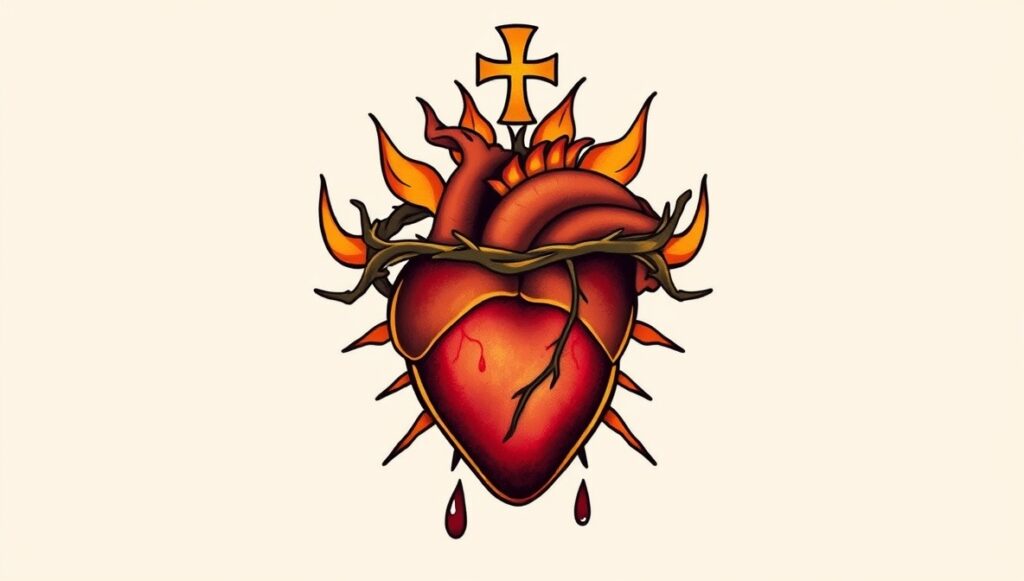
Others appreciate the sacred heart primarily for its visual character. They may choose a highly detailed traditional tattoo or a minimalist design that emphasizes the shape of the heart.
Even in a primarily artistic interpretation, the symbol retains its historical and religious associations.
Read This Butterfly Tattoo Meaning: Symbolism, Designs, and Hidden Messages
Sacred Heart Tattoo Examples
The following examples show how different design choices can communicate different personal meanings.
Friendly Examples
Example 1: A reminder of unconditional love
A person chooses a red sacred heart with golden flames to represent the love and support they have received from their family.
Meaning: Gratitude, affection, and lasting emotional connection.
Example 2: Faith through difficult times
Someone adds a small cross above the heart to commemorate a period when religious belief helped them find hope.
Meaning: Christian devotion, spiritual strength, and perseverance.
Example 3: Honoring a loved one
A person includes a small flower beside the sacred heart to remember a parent who passed away.
Meaning: Love, remembrance, and the enduring influence of someone important.
Professional Examples
Although tattoo meanings are personal rather than professional statements, the following examples illustrate how someone might explain the design in a respectful, formal setting.
Example 1: Explaining its religious significance
“My sacred heart tattoo represents my Christian faith and reminds me to approach others with compassion and understanding.”
Example 2: Explaining its personal significance
“I chose this design to symbolize resilience and the importance of remaining kind through difficult experiences.”
Example 3: Discussing its artistic inspiration
“The tattoo draws inspiration from traditional sacred heart imagery, combining religious symbolism with classic tattoo art.”
These explanations communicate the design’s significance without assuming that everyone shares the same religious beliefs.
Funny Examples
The sacred heart is a serious religious symbol for many people, so humor should be used thoughtfully. Some wearers, however, enjoy combining traditional imagery with playful personal messages.
Example 1: “My heart has a security system: flames and thorns included.”
Example 2: “Soft heart, strong boundaries.”
Example 3: “Love deeply, but read the warning label.”
These are modern, playful interpretations rather than traditional religious meanings. They work best when they reflect the wearer’s personality and do not mock beliefs that others consider sacred.
Comparison With Similar Tattoos
The sacred heart is often confused with other heart designs because they share similar shapes. However, their symbolism can differ considerably.
| Tattoo design | Main meaning | Key difference |
|---|---|---|
| Sacred heart tattoo | Divine love, faith, sacrifice, and compassion | Strong Christian religious associations |
| Flaming heart tattoo | Passion, desire, intense love, or spiritual energy | May have no specific religious meaning |
| Broken heart tattoo | Heartbreak, grief, loss, or separation | Focuses primarily on emotional pain |
| Anatomical heart tattoo | Life, mortality, courage, or emotional authenticity | Uses realistic heart anatomy |
| Heart with a dagger | Betrayal, heartbreak, sacrifice, or conflicted love | Emphasizes injury or emotional conflict |
| Sacred heart with a sword | Sorrow, sacrifice, or spiritual suffering | Combines sacred imagery with piercing or grief symbolism |
| Immaculate Heart of Mary tattoo | Mary’s love, compassion, sorrow, and devotion | Specifically associated with the Virgin Mary |
| Simple heart tattoo | Love, affection, or connection | Usually has fewer religious associations |
Sacred Heart vs. Immaculate Heart
The Sacred Heart of Jesus and the Immaculate Heart of Mary are related but distinct Christian symbols.
The Sacred Heart of Jesus emphasizes Christ’s divine and human love for humanity, including his suffering and sacrifice.
The Immaculate Heart of Mary emphasizes Mary’s love, purity, compassion, and sorrow. It is often depicted with a sword piercing the heart, sometimes accompanied by roses or flames.
Although the two designs may share visual elements, their religious meanings are not interchangeable.
Sacred Heart vs. Flaming Heart
A flaming heart can symbolize intense passion, courage, desire, or enduring love. Its meaning depends heavily on its design and context.
A sacred heart typically includes recognizable Christian imagery, such as the crown of thorns or cross. A flaming heart without these elements may communicate a more general message about love and emotional intensity.
Sacred Heart vs. Broken Heart
A broken heart usually represents the pain of losing someone, the end of a relationship, or a period of grief.
A sacred heart can include wounds and thorns, but its symbolism often extends beyond pain to encompass compassion, sacrifice, faith, and enduring love.
The distinction is important: a sacred heart does not necessarily mean romantic heartbreak.
Alternate Meanings of Sacred Heart Tattoos
Although the sacred heart has an established religious origin, its interpretation can vary according to the wearer and the surrounding artwork.
Spiritual Strength
A person may view the heart as a reminder to maintain hope and compassion during difficult circumstances.
Emotional Resilience
Thorns and wounds may represent the pain someone has experienced, while the heart itself symbolizes their determination to continue loving and caring.
Remembrance and Grief
A sacred heart combined with a name, date, or flower can honor someone who has died. In this context, it may represent love that continues beyond loss.
Personal Boundaries
Some modern wearers interpret the thorns as a reminder to protect their emotional well-being while remaining compassionate. This is a personal interpretation, not a traditional doctrinal meaning of the symbol.
Artistic or Cultural Identity
Traditional tattoo enthusiasts may choose the sacred heart because of its place in classic tattoo imagery. They may appreciate its composition and historical influence alongside its religious associations.
There is no universal rule that every sacred heart tattoo must communicate exactly the same message. The traditional symbolism provides a foundation, while personal experiences can add further significance.
Professional or Polite Alternatives for Describing the Tattoo
If someone asks about your tattoo, you can explain its meaning in different ways depending on the situation.
| Situation | Suggested explanation |
|---|---|
| Religious discussion | “It represents my faith and devotion to the Sacred Heart of Jesus.” |
| Personal conversation | “It reminds me to lead with love and compassion.” |
| Formal setting | “The design is inspired by traditional Christian symbolism.” |
| Discussion about hardship | “For me, it represents strength and compassion through difficult experiences.” |
| Artistic conversation | “I appreciate the history and symbolism of traditional sacred heart tattoo art.” |
| Private or personal setting | “It has a personal meaning that I prefer to keep private.” |
You do not need to explain every detail of a tattoo to everyone who asks. A short, honest answer is enough.
It is also helpful to avoid presenting a personal interpretation as the only correct religious meaning. Saying “For me, it represents resilience” is more accurate than claiming that resilience is the symbol’s sole traditional meaning.
Read This 444 Tattoo Meaning: Symbolism, Spiritual Signs, and Powerful Design Ideas
Common Mistakes When Interpreting Sacred Heart Tattoos
Understanding the sacred heart requires more than recognizing its shape. These common mistakes can lead to inaccurate interpretations.
1. Assuming every heart tattoo is romantic
The sacred heart is not simply a symbol of romantic love. Its traditional meaning centers on Christ’s love, compassion, and sacrifice.
2. Confusing the Sacred Heart of Jesus with the Immaculate Heart of Mary
Both symbols belong to Christian devotional art, but they refer to different figures and have distinct meanings.
3. Assuming thorns always represent heartbreak
Thorns traditionally evoke the crown of thorns associated with Christ’s Passion. A wearer may also connect them with personal suffering, but the two interpretations should not automatically be treated as identical.
4. Believing every sacred heart tattoo has the same meaning
Personal experiences influence how people interpret their tattoos. Two individuals can choose similar designs for different reasons.
5. Ignoring the symbol’s religious significance
Even when chosen for aesthetic reasons, the sacred heart has a recognizable history in Christian devotion. Learning about this background helps prevent misunderstandings.
6. Choosing a design without considering its details
A cross, sword, crown of thorns, or floral addition can change the overall impression of the tattoo. Research the specific imagery before settling on a final design.
7. Assuming placement determines the meaning
A sacred heart on the chest, arm, hand, or back does not automatically have a different symbolic definition. Placement is usually a personal or artistic choice rather than a universal code.
Quick Tips for Choosing a Sacred Heart Tattoo
If you are considering this design, the following practical tips can help you choose a tattoo that suits your intentions.
- Clarify your main message. Decide whether faith, love, remembrance, or resilience is most important to you.
- Research the traditional symbolism. Understand the difference between the Sacred Heart of Jesus and related Christian imagery.
- Choose a suitable style. Traditional designs suit bold colors and strong outlines, while fine-line and black-and-gray approaches create a more understated look.
- Think about size and detail. Small tattoos may require simplified artwork, while larger pieces can accommodate intricate thorns, flames, and shading.
- Consider placement carefully. Visibility, professional expectations, comfort, and future design plans may influence your decision.
- Discuss the design with your tattoo artist. Bring references and explain the meaning you want the artwork to communicate.
- Allow time for the decision. A meaningful tattoo deserves careful thought, especially when it incorporates religious imagery.
- Follow proper aftercare. Use a reputable, hygienic tattoo studio and follow your artist’s aftercare instructions to support healing.
The best sacred heart tattoo is one whose visual details and personal meaning align with your values.
FAQ: Sacred Heart Tattoo Meaning
1. What does a sacred heart tattoo mean?
A sacred heart tattoo traditionally symbolizes the love of Jesus Christ, Christian faith, compassion, mercy, and sacrifice. Some people also interpret it as a symbol of emotional strength, hope, or enduring love.
2. Is a sacred heart tattoo religious?
Yes, its traditional meaning is religious and comes from Christian devotion to the Sacred Heart of Jesus. However, some people choose the design for its artistic qualities or personal symbolism while recognizing its religious origins.
3. What does a sacred heart tattoo with flames mean?
Flames commonly represent divine love, spiritual passion, and the intensity of devotion. In modern personal interpretations, they may also symbolize inner strength, transformation, or a love that continues through hardship.
4. What do the thorns mean in a sacred heart tattoo?
The crown of thorns refers to the suffering of Jesus Christ during the Passion. It can represent sacrifice and suffering in its traditional religious context. Some wearers additionally connect it with personal struggles or emotional pain.
5. What does a sacred heart tattoo with a cross mean?
The cross reinforces the tattoo’s Christian meaning, representing Christ’s crucifixion, sacrifice, and salvation. Combined with the sacred heart, it emphasizes the relationship between divine love and Christ’s sacrifice for humanity.
6. Is a sacred heart tattoo good for protection?
Some people choose a sacred heart as a reminder of divine guidance, faith, and spiritual protection. However, protection is a personal religious interpretation rather than a guaranteed effect of having a tattoo.
7. What is the difference between a sacred heart and an Immaculate Heart tattoo?
The Sacred Heart of Jesus represents Christ’s love for humanity, while the Immaculate Heart of Mary represents Mary’s love, compassion, purity, and sorrow. The Immaculate Heart is frequently depicted with a sword piercing it and may include roses or flames.
8. Where should you get a sacred heart tattoo?
Popular placement options include the chest, upper arm, forearm, shoulder, and back. The best location depends on the size and detail of the design, your preferred visibility, and your personal comfort.
9. Can a sacred heart tattoo represent heartbreak?
Yes, some people use its wounded heart and thorns to express emotional pain or resilience after heartbreak. However, heartbreak is a personal interpretation rather than the symbol’s primary historical meaning.
10. What colors are best for a sacred heart tattoo?
Traditional sacred heart tattoos often use red for the heart, yellow or orange for flames, and black for outlines and shading. Black-and-gray, muted colors, and fine-line designs are also options. The best palette depends on your preferred aesthetic and the tattoo artist’s advice.
Conclusion
The sacred heart tattoo meaning brings together faith, unconditional love, compassion, sacrifice, and the strength to endure suffering. Rooted in Christian devotion to the Sacred Heart of Jesus, the design has remained recognizable because its imagery communicates powerful emotions through a combination of the heart, flames, thorns, and cross.
For some people, it is a declaration of religious belief. For others, it represents personal resilience, remembrance, or the decision to remain compassionate despite life’s difficulties.
When choosing a sacred heart tattoo, consider both its traditional religious background and your personal reasons for wearing it. Research the symbolism, select details that reflect your intended message, and work with an experienced tattoo artist to create a design that suits your style.
Ultimately, the most meaningful tattoo is one that reflects your values while respecting the history behind its imagery.