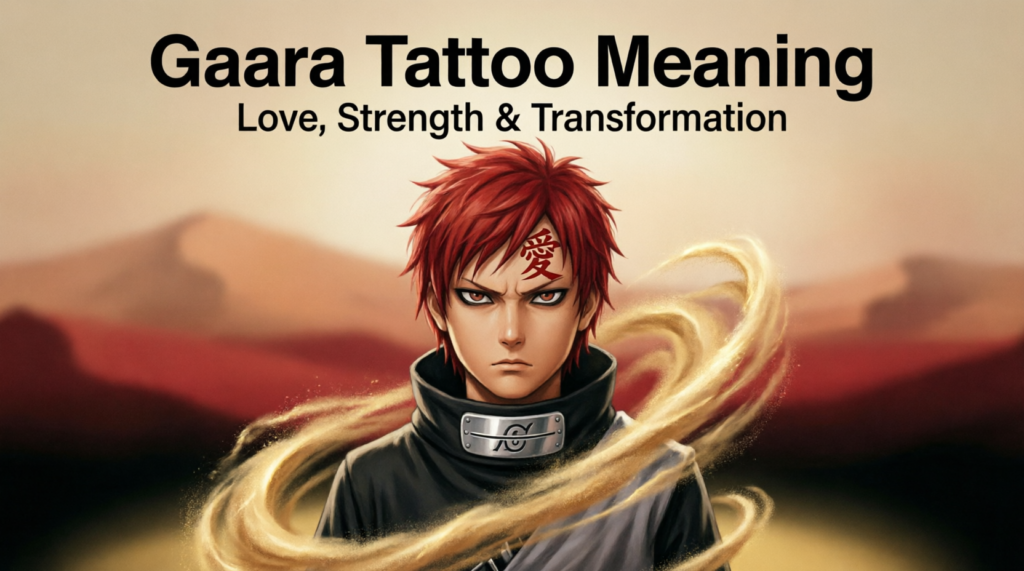
The Gaara tattoo meaning is closely connected to the Japanese anime and manga series Naruto. Gaara’s forehead tattoo features the kanji character 愛, which means “love.” It represents his painful journey from loneliness and rejection toward self-acceptance, inner strength, and a desire to protect others. For many fans, this tattoo symbolizes surviving emotional pain, finding personal identity, and learning to love oneself.
Gaara Tattoo Meaning & Definition
The Gaara tattoo is one of the most recognizable symbols in the Naruto universe. It appears on the forehead of Gaara, a character who grows up feeling isolated, feared, and misunderstood. The red character on his forehead is the Japanese kanji 愛 (ai), meaning “love.”
However, the meaning behind this tattoo is more complicated than its simple translation. In Gaara’s early life, the symbol represents a painful promise to love himself because he believes nobody else will ever love him. As his character develops, that meaning becomes connected to healing, friendship, compassion, and protecting the people who matter to him.
People who choose a Gaara tattoo may connect with several ideas:
- Self-love: Learning to value yourself without depending entirely on other people’s approval.
- Loneliness and survival: Finding the strength to continue after rejection or emotional hardship.
- Personal transformation: Moving beyond anger, pain, or a difficult past.
- Emotional resilience: Remaining strong even when life feels unfair.
- Protection: Standing up for loved ones and protecting those who cannot protect themselves.
- Individuality: Accepting the parts of yourself that other people may misunderstand.
The tattoo can have a different meaning for every person. Some people choose it because Gaara is their favorite anime character, while others relate to his emotional struggles and personal growth.
Introduction: Why Gaara’s Tattoo Has Such a Powerful Meaning
Anime tattoos often represent more than a favorite character or memorable scene. They can communicate personal experiences, values, and emotions that are difficult to explain in ordinary words. Gaara’s forehead tattoo is a particularly meaningful example because its symbolism is closely tied to his character development.
When viewers first meet Gaara in Naruto, he appears dangerous, emotionally distant, and almost impossible to understand. His childhood has been shaped by fear, rejection, and the belief that his existence is a burden to others. As a result, he develops a harsh view of the world and struggles to trust anyone.
The kanji on his forehead reflects this emotional history. It is a permanent reminder of the moment when Gaara decides that he will live for himself, even if nobody else accepts him.
Yet Gaara’s story does not end with isolation. His encounters with Naruto and other characters gradually change his understanding of strength, relationships, and responsibility.
This transformation gives the Gaara tattoo several layers of meaning. It can represent the pain someone has experienced, the identity they built to survive, and the possibility of becoming a kinder person without forgetting their past.
For anime fans, the tattoo also carries a connection to one of the most memorable character arcs in Naruto. For people who relate to Gaara personally, it may serve as a reminder that a difficult beginning does not have to determine the rest of their lives.
Origin of Gaara’s Forehead Tattoo
Gaara’s tattoo originates in Naruto, the popular Japanese manga created by Masashi Kishimoto. Gaara is introduced as a shinobi from Sunagakure, also known as the Hidden Sand Village.
His early life is marked by tragedy. As the jinchūriki of Shukaku, the One-Tailed Beast, he is feared because of the dangerous power sealed inside him. His father, the Fourth Kazekage, treats him as a weapon, and Gaara experiences rejection from people who should have protected him.
These experiences contribute to his belief that he cannot depend on anyone else for affection or acceptance.
What Does the Kanji on Gaara’s Forehead Mean?
The character is 愛, pronounced ai in Japanese. Its basic meaning is love, affection, or deep care.
In Gaara’s story, the character has a specific emotional context. After a devastating betrayal, he decides to love only himself and live for his own sake. He marks his forehead with the kanji as a physical expression of that decision.
This is why the tattoo is often associated with self-love, although its original meaning within the story is darker and more complicated than a simple message of confidence.
Read This Semicolon Tattoo Meaning: Hope, Healing, and a Reason to Keep Going
Why Does Gaara Have the Tattoo?
Gaara creates the tattoo after experiencing a major emotional turning point involving Yashamaru, his uncle and caretaker. The betrayal leaves him feeling that the affection he believed he had received was not genuine.
In response, Gaara embraces the idea that he must exist for himself alone. The tattoo becomes a permanent expression of that painful belief.
As the story progresses, however, Gaara learns that strength does not require complete isolation. Naruto helps him recognize that meaningful relationships and compassion can coexist with personal strength.
Consequently, the tattoo can be interpreted differently depending on which stage of Gaara’s life a person relates to: his early loneliness or his later transformation.
Why Is the Gaara Tattoo So Popular?
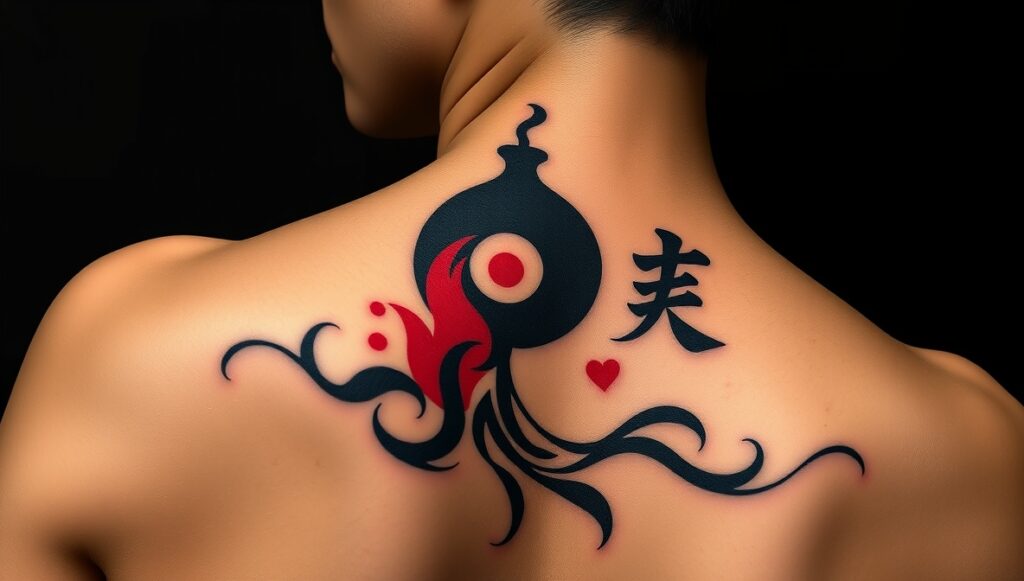
Gaara’s tattoo remains popular among anime fans because it combines a simple visual design with a complex character story.
Unlike a large portrait or detailed anime scene, the original symbol is relatively small. Its clean, recognizable appearance makes it adaptable to different tattoo styles and placements.
Several factors contribute to its popularity.
1. A Strong Message About Self-Love
The word “love” has universal appeal, but Gaara’s connection to it makes the symbol especially meaningful. It reminds some fans that self-respect can become important when they feel rejected or misunderstood.
2. A Connection to Gaara’s Character Development
Gaara begins as a feared and isolated character but eventually becomes a respected leader and protector. Fans who appreciate his development may use the tattoo to represent their own growth.
3. Recognition Among Naruto Fans
The red forehead symbol is immediately recognizable to many fans of the series. It can communicate an interest in anime without requiring a large or complicated design.
4. A Minimalist Appearance
The original design is visually simple, making it suitable for people who prefer small tattoos. It can also be incorporated into more elaborate artwork featuring Gaara, sand, or elements associated with the Hidden Sand Village.
5. A Personal Reminder of Resilience
Some people connect the symbol with overcoming difficult circumstances. Rather than representing suffering alone, it can remind them that their past does not have to define their future.
How the Gaara Tattoo Is Used in Real Life
In real life, the Gaara tattoo is mainly chosen as personal body art. Its meaning depends on the wearer’s connection to the character, the anime, and the concept of self-love.
Here are common ways people interpret or use the design.
As a Symbol of Self-Love
Someone who has learned to respect themselves after a difficult relationship may choose the tattoo as a reminder of personal worth.
For example, a person might explain it by saying, “This tattoo reminds me that I deserve love, even when other people fail to show it.”
As a Symbol of Surviving Loneliness
Gaara’s early experiences resonate with viewers who have felt excluded, misunderstood, or isolated. For these individuals, the tattoo may represent survival rather than a desire to remain alone.
As a Reminder of Personal Growth
People sometimes associate the tattoo with the difference between who they were in the past and who they have become.
It can represent the decision to stop letting painful experiences control their actions.
As a Tribute to Naruto
Some people choose the tattoo simply because Gaara is an important character in their favorite anime. They may admire his fighting style, design, personality, or transformation.
There is no requirement that every person with a Gaara tattoo must have experienced the same emotional struggles as the character.
As a Symbol of Protection
Gaara eventually becomes a leader who cares deeply about his village. For some fans, the tattoo represents a willingness to protect family, friends, and others who need support.
Gaara Tattoo Meaning Examples
The following examples show how someone might explain the symbolism behind this tattoo in different situations.
Friendly Examples
These examples use a personal, relaxed tone suitable for conversations with friends.
- “I got Gaara’s tattoo because his story reminds me to love myself.”
- “For me, it represents surviving difficult times and becoming stronger.”
- “I’m a huge Naruto fan, and Gaara’s character development means a lot to me.”
- “The tattoo reminds me that I can grow beyond my past.”
- “I love how such a simple symbol carries so much emotional meaning.”
These explanations are useful when someone asks about the tattoo out of curiosity or shares an interest in anime.
Professional Examples
A professional tone may be appropriate when discussing the tattoo in an interview, workplace conversation, or formal setting.
- “The design represents self-respect, resilience, and personal development.”
- “I chose this symbol because it reflects the importance of understanding and accepting myself.”
- “It has personal significance because it reminds me to approach difficult experiences with strength and compassion.”
- “The tattoo is inspired by a fictional character whose journey emphasizes the value of connection and growth.”
These statements focus on the personal meaning rather than assuming the listener knows the anime.
Funny Examples
Some fans prefer a playful explanation, especially when speaking with other anime enthusiasts.
- “It’s my reminder to love myself, even when my favorite character has more emotional baggage than I do.”
- “I wanted a reminder of self-love, and Gaara made it look cooler.”
- “It’s anime therapy, but permanent.”
- “The sand ninja taught me more about personal growth than I expected.”
- “It’s a small tattoo with an entire Naruto character arc behind it.”
Humor can make the explanation more casual, but the tattoo’s meaning remains personal.
Comparison With Similar Anime Tattoos and Symbols
The Gaara tattoo is often compared with other meaningful anime tattoos and symbols. Although these designs may share themes of strength, pain, or personal growth, their original meanings are different.
| Tattoo or symbol | Main meaning | How it differs from Gaara’s tattoo |
|---|---|---|
| Gaara’s forehead tattoo | Love, initially connected to isolation and self-preservation | Represents a complex journey from loneliness toward connection |
| Naruto’s whisker marks | His connection to Kurama and his unusual circumstances from birth | Identifies a character trait rather than directly spelling out a concept |
| Itachi’s crow imagery | Often associated with sacrifice, secrecy, and the Uchiha story | Focuses more on sacrifice and hidden truths |
| Sasuke’s curse mark | Power, temptation, and the consequences of seeking strength | Represents a dangerous influence and internal conflict |
| Akatsuki cloud | The Akatsuki organization and its role in the story | Primarily an organizational symbol |
| Semicolon tattoo | Continuing life after a difficult chapter, commonly linked to mental health awareness | Has a real-world symbolic association independent of an anime character |
| Butterfly tattoo | Transformation, renewal, and change | Usually emphasizes transformation rather than Gaara’s specific story |
These comparisons are general interpretations. Personal meanings can differ from person to person, and anime symbols may carry additional significance depending on the story.
Gaara Tattoo vs. a General Love Tattoo
A traditional heart or the word “love” usually communicates affection, romance, or emotional connection. Gaara’s tattoo has a more specific narrative behind it.
It begins as an expression of self-directed love shaped by rejection. His later development adds themes of empathy, friendship, and responsibility.
Therefore, a Gaara tattoo may communicate a more complicated relationship with love than a conventional heart design.
Gaara Tattoo vs. a Self-Love Quote
A self-love quote usually states its message directly. Gaara’s symbol communicates through a combination of Japanese writing and the character’s story.
Someone who recognizes the reference may understand its connection to loneliness and growth. Someone unfamiliar with Naruto may simply see a kanji character meaning love.
Both designs can be meaningful, but the Gaara tattoo carries a specific connection to anime culture.
Read This Butterfly Tattoo Meaning: Symbolism, Designs, and Hidden Messages
Alternate Meanings of the Gaara Tattoo
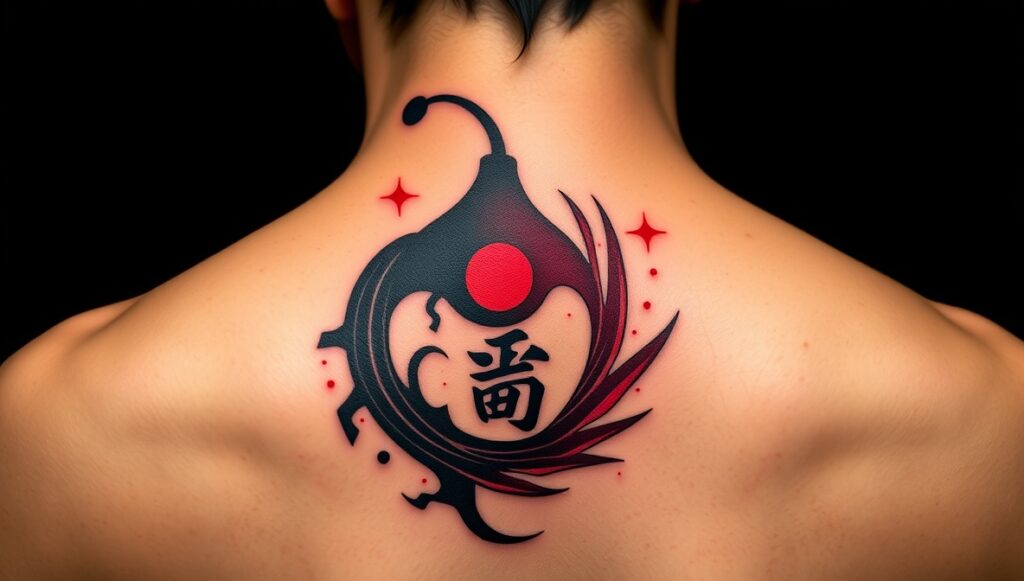
Although the kanji itself means love, the tattoo does not have one universal interpretation. Different people may connect it with different stages of Gaara’s story.
1. Self-Love and Independence
The most direct interpretation is learning to value yourself. This can mean developing confidence, setting boundaries, and refusing to measure your worth entirely through other people’s opinions.
2. Loneliness and Emotional Pain
Because Gaara initially associates love with rejection and isolation, the tattoo may remind some fans of the emotional cost of feeling unwanted.
For others, it represents the point at which they decided to survive despite their circumstances.
3. Transformation and Redemption
Gaara’s later life demonstrates that people can change. His tattoo can therefore represent a shift from anger and distrust toward compassion and meaningful relationships.
4. Strength and Protection
As Gaara matures, he learns to use his strength to protect others. The tattoo can symbolize becoming someone who offers the support they once needed.
5. Anime Fandom
Not every interpretation needs to be deeply personal. The tattoo can simply celebrate a beloved character or an important part of someone’s experience with Naruto.
Important distinction: The character 愛 means “love.” Meanings such as resilience, loneliness, redemption, and protection come from Gaara’s fictional history and fans’ interpretations; they are not literal translations of the kanji.
Professional or Polite Alternatives to Explaining the Tattoo
If someone asks what your Gaara tattoo means, you can explain it in different ways depending on the setting.
| Situation | Suggested explanation |
|---|---|
| Casual conversation | “It’s inspired by Gaara from Naruto, and it represents self-love to me.” |
| A personal discussion | “It reminds me that difficult experiences don’t have to define who I become.” |
| A professional setting | “It’s a personal symbol of resilience, self-respect, and growth.” |
| Talking to an anime fan | “It’s Gaara’s forehead tattoo, and its meaning changes as his character develops.” |
| Keeping the meaning private | “It has a personal meaning that I prefer to keep to myself.” |
| Explaining it to someone unfamiliar with anime | “It’s a Japanese character meaning love, inspired by a character from an anime series.” |
You do not need to share personal experiences to justify a tattoo. A brief explanation is enough, and you can decide how much of its meaning you want to discuss.
Common Mistakes About Gaara’s Tattoo Meaning
Even though the design is recognizable, several misunderstandings are common.
Mistake 1: Assuming It Only Means Self-Love
Self-love is an important interpretation, but it does not capture the entire story. Gaara initially adopts the symbol after experiencing rejection and betrayal.
His later transformation adds themes of connection, compassion, and protecting others.
Mistake 2: Confusing the Kanji With Its Story-Based Meaning
The Japanese character 愛 means love. It does not literally translate to “loneliness,” “strength,” or “redemption.”
Those additional meanings come from Gaara’s experiences and the way fans interpret his character.
Mistake 3: Assuming Everyone With the Tattoo Has Experienced Trauma
A person may choose the design because they love Naruto, admire Gaara, or appreciate Japanese writing. It is not appropriate to assume that the tattoo reveals someone’s emotional history.
Mistake 4: Believing the Tattoo Has One Fixed Personal Meaning
People connect with fictional characters in different ways. One person may associate Gaara with self-respect, while another may see him as a symbol of change or loyalty.
Neither interpretation has to be identical to the other’s.
Mistake 5: Ignoring the Importance of Accurate Japanese Writing
If you plan to get the kanji tattooed, verify the character carefully. The intended symbol is 愛.
Before committing, consult a reliable Japanese-language reference and ask your tattoo artist to confirm the exact design. Decorative fonts, unusual brush styles, or incorrect characters can change the appearance of the intended symbol.
Quick Tips Before Getting a Gaara Tattoo
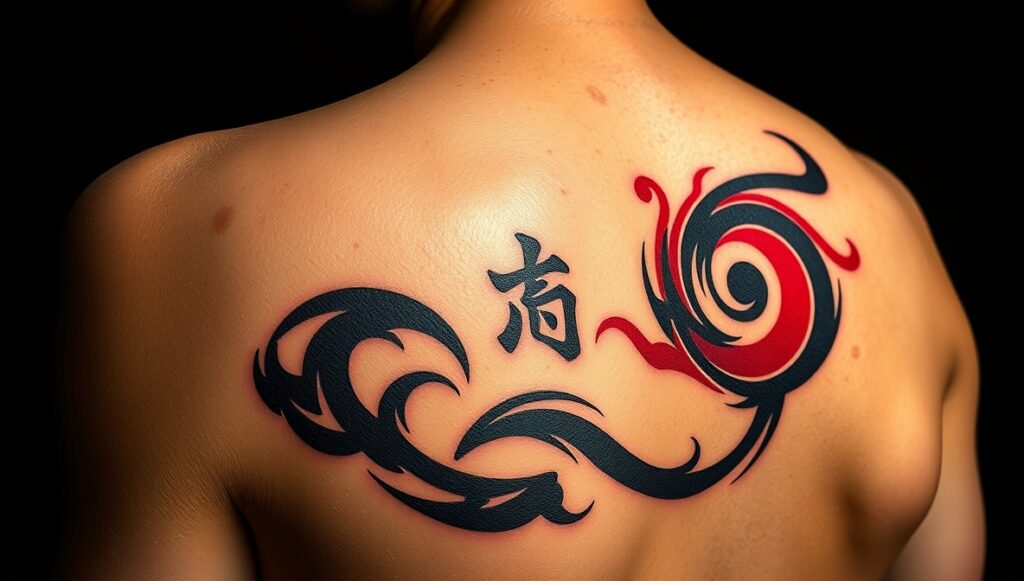
If you are considering this design, a little preparation can help you choose something that remains meaningful over time.
- Decide what the tattoo means to you. Is it self-love, personal growth, fandom, or a combination of these ideas?
- Choose the right design. You can use the original red kanji, a black-ink version, or a larger composition featuring Gaara.
- Think about placement. Common options include the forearm, wrist, upper arm, shoulder, and back. A forehead placement recreates the anime design but is highly visible.
- Check the character. Make sure the kanji is correct before the artist begins.
- Consider size and readability. Very small lettering may lose detail as a tattoo ages.
- Choose a qualified tattoo artist. Look for healed examples of their lettering work and follow appropriate hygiene and aftercare guidance.
- Consider your long-term preferences. Visible tattoos can affect workplace expectations in some settings, so think carefully before choosing a highly exposed placement.
- Make the design personal. You can incorporate sand patterns, a subtle red accent, or other Naruto-inspired details without losing the original symbol.
A meaningful tattoo does not need to be large or complicated. Sometimes a small design is enough to represent a character or idea that has stayed with you for years.
FAQ About Gaara Tattoo Meaning
1. What does Gaara’s tattoo mean?
Gaara’s forehead tattoo features the Japanese kanji 愛, meaning “love.” In the story, it initially represents his decision to love himself after experiencing rejection and betrayal. It later becomes associated with personal growth, compassion, and his changing understanding of relationships.
2. Why does Gaara have the word love on his forehead?
Gaara marks his forehead after a painful betrayal involving his uncle, Yashamaru. Feeling that nobody truly loves him, he decides to live for himself. The tattoo expresses that decision and the emotional isolation he experiences at that point in his life.
3. What is the Japanese symbol on Gaara’s forehead?
The symbol is 愛, pronounced ai in Japanese. It means love or affection. Its significance in Naruto comes from Gaara’s personal history rather than from a different literal translation.
4. Is Gaara’s tattoo a symbol of self-love?
Yes, self-love is one of its most common interpretations. However, the symbol originally reflects a defensive response to rejection. Gaara’s character development gives it a broader meaning connected to healing, friendship, empathy, and protecting others.
5. What does a Gaara tattoo mean in real life?
In real life, it may represent self-respect, resilience, overcoming loneliness, personal transformation, or admiration for Naruto. The meaning depends on the person wearing it. Some fans also choose the design simply because Gaara is their favorite character.
6. Is Gaara’s tattoo considered a good tattoo idea?
It can be a meaningful choice for anime fans and people who connect with its themes. Before getting it, consider its visibility, your preferred design, the accuracy of the kanji, and whether you will remain comfortable with the tattoo over time.
7. What is the difference between Gaara’s tattoo and a normal love symbol?
A conventional heart or love tattoo usually represents affection, romance, or connection. Gaara’s tattoo also carries the character’s history of rejection and isolation, along with his later growth. Its meaning is therefore more specific to the Naruto story.
8. Where should I get a Gaara tattoo?
Popular placements include the forearm, wrist, upper arm, shoulder, and back. The forehead is an option for those who want to recreate Gaara’s original appearance, but it is highly visible. Choose a location based on your style, professional circumstances, and comfort.
9. Does Gaara’s tattoo mean loneliness?
Not literally. The kanji means love, but Gaara’s early story connects it with loneliness because he believes he must rely only on himself. Fans may interpret the design as a reminder of surviving isolation and eventually building healthier relationships.
10. Can I get Gaara’s tattoo if I am not a Naruto fan?
Yes. You can appreciate the symbol’s meaning of love or connect with its broader themes without being a dedicated anime fan. However, understanding the character’s story helps explain why the design carries a more complicated meaning than the kanji alone.
Conclusion
The Gaara tattoo meaning goes far beyond the simple translation of a Japanese character. The kanji 愛 means love, but its emotional significance comes from Gaara’s journey through rejection, loneliness, anger, and eventual personal growth.
At first, the tattoo represents his decision to depend only on himself. Over time, his experiences teach him that real strength can also include trust, friendship, compassion, and responsibility toward others.
For people who choose this design, it may represent self-love, resilience, transformation, or a lasting connection to Naruto. Others may simply appreciate its clean appearance and recognize it as a tribute to a memorable anime character.
If you are considering getting a Gaara tattoo, the most important step is to understand what it means to you personally. Choose an accurate design, consider its placement, and let its significance reflect your own values rather than assuming that everyone must interpret it the same way.
Ultimately, the tattoo offers a powerful reminder: your past may shape your story, but it does not have to determine who you become.