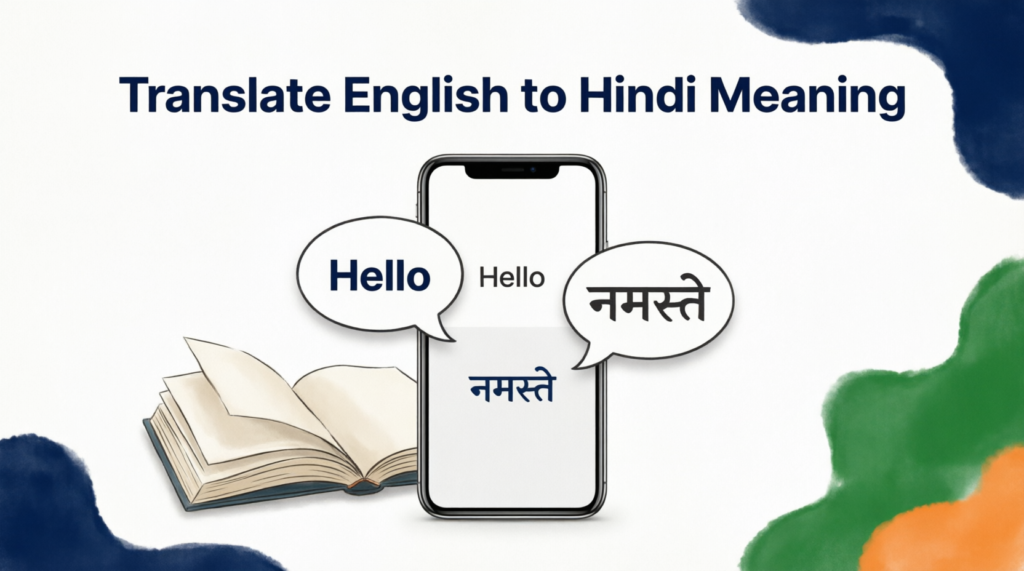
“Translate English to Hindi meaning” refers to understanding the meaning of English words, phrases, or sentences in Hindi. It helps Hindi speakers learn English vocabulary, understand conversations, and express ideas accurately in their preferred language.
Translate English to Hindi Meaning: Meaning and Definition
The phrase “translate English to Hindi meaning” is commonly used by people who want to know what an English word, sentence, or expression means in Hindi. For example, someone might search for “good morning translate English to Hindi meaning” to learn that “Good morning” means “सुप्रभात” (Suprabhat) or, in everyday conversation, “आपको सुप्रभात” depending on context.
English and Hindi are different languages, so translating between them involves more than replacing individual words. A good translation communicates the original message, tone, and intention in a way that sounds natural to Hindi speakers.
For example:
- English: How are you?
- Hindi: आप कैसे हैं? (Aap kaise hain?)
- English: Thank you.
- Hindi: धन्यवाद। (Dhanyavaad.)
- English: I am happy.
- Hindi: मैं खुश हूँ। (Main khush hoon.)
Translations may change according to the speaker, listener, situation, and level of formality. Understanding these differences helps learners communicate more confidently.
Introduction
English is widely used in education, business, technology, travel, entertainment, and online communication. However, not everyone understands English easily, especially when a sentence contains unfamiliar vocabulary, idioms, or complex grammar. Hindi translation makes this information easier to understand.
People search for translate English to Hindi meaning for many reasons. Students may need help understanding textbook passages, professionals may want to understand workplace emails, and language learners may wish to improve their vocabulary. Others simply want to understand the meaning of a message they received online.
Translation can be useful for everyday expressions, such as greetings, questions, requests, and emotional statements. It can also help explain complicated subjects by presenting information in familiar language.
Consider the sentence “I am looking forward to meeting you.” Translating every word separately may produce an awkward Hindi sentence. A natural translation is “मैं आपसे मिलने के लिए उत्सुक हूँ।” (Main aapse milne ke liye utsuk hoon.)
This example shows why context matters. The purpose of translation is not merely to convert words. It is to preserve the meaning of the original message.
Whether you are a beginner or an advanced learner, understanding English-to-Hindi translation can make reading, writing, and speaking easier.
Read This Translate to English in Hindi Meaning: Easy Guide With Examples
Origin of English-to-Hindi Translation
English-to-Hindi translation developed through historical contact between English-speaking communities and Hindi-speaking populations. During British rule in the Indian subcontinent, English became increasingly important in administration, education, law, and trade. Contact between the languages encouraged the development of dictionaries, translated texts, educational materials, and bilingual communication.
Hindi has a long literary tradition, while English developed from Germanic languages and later incorporated vocabulary from Latin, French, and many other languages. Because the two languages developed in different linguistic environments, their grammar, sentence structure, and vocabulary often differ considerably.
For instance, English commonly follows a subject-verb-object structure:
- English: I eat an apple.
- Hindi: मैं एक सेब खाता हूँ। (Main ek seb khata hoon.)
Hindi commonly places the verb toward the end of the sentence. It also uses grammatical gender in ways that affect certain verb forms and adjectives.
Modern translation has become easier with printed dictionaries, bilingual learning books, websites, mobile applications, and artificial intelligence tools. Today, people can translate a word or a complete paragraph within seconds, although important documents still require careful human review.
The basic goal remains the same: to communicate meaning accurately between people who use different languages.
Popularity of English-to-Hindi Translation
English-to-Hindi translation is popular because both languages are used by millions of people in education, professional communication, entertainment, and daily life.
Many Hindi speakers encounter English through school lessons, websites, social media, advertisements, films, and mobile applications. When an unfamiliar phrase appears, translating it into Hindi provides a quick way to understand it.
Several factors contribute to the popularity of online translation.
- Education: Students use translations to understand lessons, definitions, and examination questions.
- Vocabulary building: Learners discover Hindi meanings of new English words.
- Workplace communication: Employees use translation to understand instructions, emails, and professional documents.
- Social media: People translate captions, comments, quotes, and messages.
- Travel: Visitors use translations to understand signs, directions, and common questions.
- Digital accessibility: Translation helps readers understand information that might otherwise be difficult to follow.
Searches for phrases such as “English words with Hindi meaning,” “translate English sentences into Hindi,” and “English to Hindi dictionary” reflect different translation needs.
However, popularity does not mean that every automatic translation is perfect. Slang, humour, idioms, regional expressions, and technical language can be difficult for translation tools to interpret correctly.
How to Translate English to Hindi Meaning
Translating English into Hindi becomes easier when you follow a few practical steps. The best method depends on whether you are translating a single word, a short expression, or a complete sentence.
1. Identify the English Word or Sentence
Start by identifying exactly what you want to understand. A single word may have several meanings, while a complete sentence usually provides more context.
For example, the English word “light” can refer to illumination, something that is not heavy, or a pale colour.
- Light from the sun: सूरज की रोशनी (Suraj ki roshni)
- A light bag: हल्का बैग (Halka bag)
- A light colour: हल्का रंग (Halka rang)
The surrounding sentence helps determine the correct meaning.
2. Understand the Context
Context is one of the most important parts of accurate translation. The same English expression can have different Hindi equivalents depending on how it is used.
For example, “That is cool” may refer to a low temperature or express approval.

- Temperature: वह ठंडा है। (Woh thanda hai.)
- Approval: यह बढ़िया है। (Yeh badhiya hai.)
Translating without considering context may change the speaker’s intended meaning.
3. Choose Natural Hindi Words
A word-for-word translation may be grammatically incorrect or sound unnatural. Instead, select Hindi expressions that communicate the same idea.
For example:
- English: What is your name?
- Natural Hindi: आपका नाम क्या है? (Aapka naam kya hai?)
The goal is to create a sentence that Hindi speakers can understand easily.
4. Check the Tone and Formality
Some expressions are suitable for friends, while others are better for teachers, customers, or professional contacts.
For example:
- Informal: तुम कैसे हो? (Tum kaise ho?)
- Respectful: आप कैसे हैं? (Aap kaise hain?)
Both mean “How are you?” but they communicate different levels of respect and familiarity.
5. Review the Final Translation
After translating, read the Hindi sentence and ask whether it communicates the original message. For important content, verify names, dates, numbers, technical terms, and formal expressions.
For legal, medical, or official documents, use a qualified translator when accuracy has serious consequences.
English-to-Hindi Translation Examples
The following examples show how common English expressions can be translated into Hindi. Roman Hindi is included to help readers who cannot yet read Devanagari confidently.
| English phrase | Hindi meaning | Roman Hindi |
|---|---|---|
| Good morning | सुप्रभात | Suprabhat |
| How are you? | आप कैसे हैं? | Aap kaise hain? |
| Thank you | धन्यवाद | Dhanyavaad |
| Please help me | कृपया मेरी मदद करें | Kripya meri madad karein |
| I am happy | मैं खुश हूँ | Main khush hoon |
| I don’t understand | मुझे समझ नहीं आया | Mujhe samajh nahi aaya |
| What are you doing? | आप क्या कर रहे हैं? | Aap kya kar rahe hain? |
| See you later | फिर मिलते हैं | Phir milte hain |
| I am learning English | मैं अंग्रेज़ी सीख रहा/रही हूँ | Main Angrezi seekh raha/rahi hoon |
| Have a nice day | आपका दिन शुभ हो | Aapka din shubh ho |
Some translations have multiple acceptable versions. For instance, “Thank you” can be translated as “धन्यवाद” or expressed through a more conversational phrase, depending on the situation.
Read This Tagalog in English Words With Meaning: 100+ Everyday Filipino Words to Learn
Friendly Examples
Friendly translations are useful for conversations with friends, relatives, classmates, and people you know well.
| English sentence | Hindi translation | Tone |
|---|---|---|
| What’s up? | क्या चल रहा है? | Casual |
| Don’t worry | चिंता मत करो | Reassuring |
| You are amazing | तुम कमाल हो | Warm and friendly |
| I miss you | मुझे तुम्हारी याद आती है | Affectionate |
| Let’s go together | चलो साथ चलते हैं | Inviting |
| That sounds great! | यह तो बहुत अच्छा लग रहा है! | Excited |
| Haha, that’s funny! | हाहा, यह मज़ेदार है! | Playful |
In informal conversations, expressions may be shortened or changed to sound more natural. Emojis can also affect tone. For example, “ठीक है 😊” feels warmer than a plain “ठीक है।” However, an emoji should not replace clear wording when the message is important.
Professional Examples
Professional translation requires clarity, courtesy, and an appropriate level of formality. These examples are useful for workplace messages, academic communication, and customer service.
| English sentence | Hindi translation | Purpose |
|---|---|---|
| Please send the report. | कृपया रिपोर्ट भेज दें। | Polite request |
| Thank you for your support. | आपके सहयोग के लिए धन्यवाद। | Appreciation |
| I will contact you tomorrow. | मैं आपसे कल संपर्क करूँगा/करूँगी। | Follow-up |
| Could you explain this again? | क्या आप इसे दोबारा समझा सकते हैं? | Respectful question |
| Please let me know if you need assistance. | यदि आपको सहायता चाहिए, तो कृपया मुझे बताएं। | Customer support |
| We appreciate your feedback. | हम आपकी प्रतिक्रिया की सराहना करते हैं। | Professional appreciation |
Notice that formal Hindi often uses “आप” instead of “तुम” or “तू.” This choice helps communicate respect and professionalism.
When translating a business email, preserve the original meaning and avoid adding promises, deadlines, or commitments that do not appear in the English text.
Funny Examples
Humour can be difficult to translate because jokes often depend on wordplay, cultural references, or double meanings. A direct translation may not produce the same effect.
| English expression | Hindi version | Explanation |
|---|---|---|
| I’m on a seafood diet. I see food and eat it. | मैं सी-फूड डाइट पर हूँ। खाना दिखता है, तो खा लेता/लेती हूँ। | A joke based on similar-sounding words |
| I’m not lazy; I’m on energy-saving mode. | मैं आलसी नहीं हूँ; मैं ऊर्जा बचाने वाले मोड में हूँ। | A playful excuse |
| My bed and I are perfect for each other. | मेरा बिस्तर और मैं एक-दूसरे के लिए बने हैं। | A joke about loving sleep |
| I need six months of vacation twice a year. | मुझे साल में दो बार छह-छह महीने की छुट्टी चाहिए। | An exaggerated wish |
These translations preserve the general humour, but some jokes may work better when adapted rather than translated word for word.
Comparison With Similar Terms
People use several related phrases when searching for English-to-Hindi translations. Although they may seem interchangeable, their purposes can differ slightly.
| Term | Meaning | Best use |
|---|---|---|
| Translate English to Hindi | Convert English text into Hindi | Translating words, sentences, or documents |
| English to Hindi meaning | Find the Hindi meaning of English vocabulary or expressions | Vocabulary learning |
| English to Hindi translation | The process or result of converting English into Hindi | General translation tasks |
| Hindi to English meaning | Understand Hindi words or sentences in English | Reverse translation |
| English to Hindi dictionary | A reference containing English words and Hindi equivalents | Looking up individual words |
| English to Hindi transliteration | Represent English sounds or words using another script | Writing pronunciation in Devanagari |
| English to Hindi pronunciation | Learn how an English word is spoken, sometimes with Hindi guidance | Speaking practice |
Translation vs. Transliteration
Translation and transliteration are not the same.
Translation communicates meaning in another language. Transliteration represents the sounds or spelling of a word using a different writing system.
For example:
- English word: Water
- Hindi translation: पानी (Paani)
- Transliteration of “water” into Devanagari: वॉटर (approximately, depending on pronunciation)
“पानी” communicates the meaning of water, while “वॉटर” represents the English word’s sound. This difference is important when learning vocabulary or using language tools.
Translation vs. Meaning
A word’s meaning is the idea it communicates. Translation is the process of expressing that idea in another language.
For example, “beautiful” means attractive or pleasing to look at. Its Hindi equivalents may include “सुंदर” (Sundar), “खूबसूरत” (Khoobsurat), or “मनमोहक” (Manmohak). The best choice depends on the sentence and the intended tone.
Alternate Meanings and Translation Challenges
The phrase “translate English to Hindi meaning” generally refers to language translation, but individual words may have several meanings depending on context.
Consider the word “right.” It can mean correct, a direction, or an entitlement.
- You are right: आप सही हैं।
- Turn right: दाएँ मुड़ें।
- Human rights: मानवाधिकार।
A dictionary may list several translations, but the full sentence determines which one is appropriate.
Idioms create another challenge. The phrase “break the ice” usually means to make people feel more comfortable in a social situation. Translating it literally as “बर्फ तोड़ना” would not communicate the intended figurative meaning in most conversations.
A natural Hindi explanation could be “बातचीत की झिझक दूर करना” or “माहौल को सहज बनाना.”
Other common challenges include:
- Gender: Some Hindi verb forms change depending on the speaker’s gender.
- Respect: Hindi pronouns and verb forms can indicate familiarity or politeness.
- Regional vocabulary: Some words vary across Hindi-speaking regions.
- Technical language: Medical, legal, and scientific terms may require specialized knowledge.
- Sarcasm: The literal words may express the opposite of the speaker’s intention.
- Cultural references: Certain jokes, traditions, or expressions need explanation rather than direct translation.
Recognizing these challenges leads to more accurate and natural translations.
Professional or Polite Alternatives
When translating requests, instructions, and business messages, the right wording can make communication clearer and more respectful.
| Basic English | More polite English | Natural Hindi equivalent |
|---|---|---|
| Send me the file. | Could you please send me the file? | क्या आप कृपया मुझे फ़ाइल भेज सकते हैं? |
| Explain this. | Could you explain this to me? | क्या आप मुझे यह समझा सकते हैं? |
| Reply soon. | Please respond when you have a chance. | कृपया समय मिलने पर जवाब दें। |
| I need help. | Could you please assist me? | क्या आप कृपया मेरी सहायता कर सकते हैं? |
| Tell me the details. | Could you please share the details? | क्या आप कृपया विवरण साझा कर सकते हैं? |
| I disagree. | I see your point, but I have a different view. | मैं आपकी बात समझता/समझती हूँ, लेकिन मेरी राय अलग है। |
A professional translation should preserve the speaker’s intention without making the message unnecessarily harsh or overly formal.
For example, “Give me the answer now” sounds demanding. “Could you please share the answer when possible?” is more courteous. In Hindi, “कृपया संभव हो तो उत्तर साझा करें” offers a similarly polite tone.
Common Mistakes When Translating English to Hindi
Even experienced learners can make mistakes when translating between English and Hindi. Avoiding the following problems can improve accuracy.
Translating Every Word Literally
English and Hindi use different sentence structures. Translating every word separately may produce confusing or unnatural sentences.
Better approach: Translate the complete idea and then check whether the Hindi sentence sounds natural.
Ignoring Gender Agreement
Hindi commonly changes certain verb forms according to gender.
For example:
- Male speaker: मैं जा रहा हूँ। (Main ja raha hoon.)
- Female speaker: मैं जा रही हूँ। (Main ja rahi hoon.)
The English sentence “I am going” does not show this distinction, but Hindi often does.
Read This Pronóstico Meaning in English: Definition, Examples, and Spanish Usage
Confusing Respectful and Informal Language
Using “तू,” “तुम,” or “आप” without considering the relationship can make a sentence sound rude, familiar, or respectful.
Better approach: Use “आप” when speaking to strangers, customers, teachers, or people you want to address respectfully.
Misunderstanding Idioms
Idioms often have figurative meanings that cannot be understood by translating each word.
For example, “once in a blue moon” means something happens very rarely. A natural Hindi equivalent is “कभी-कभार” or “बहुत कम।”
Trusting Automatic Translation Without Checking
Translation applications can be helpful, but they may misunderstand context, names, slang, or specialized terms.
Better approach: Check the result against the original sentence. Use a reliable dictionary or a qualified translator for important material.
Using Unnatural Formal Language
A translation can be technically understandable but sound too stiff for a friendly conversation.
Better approach: Match the language to the audience and situation. A message to a friend does not need to sound like an official notice.
Quick Tips for Better English-to-Hindi Translation
Use these simple tips to improve your translation skills.
- Translate complete sentences when possible. Context helps identify the intended meaning.
- Learn words in phrases. Memorizing “take care” as “अपना ध्यान रखना” is often more useful than translating “take” and “care” separately.
- Check multiple meanings. Words such as “light,” “right,” and “fair” have several possible translations.
- Pay attention to tone. Friendly, formal, sarcastic, and emotional expressions may require different wording.
- Practice reading Hindi aloud. Speaking the translated sentence can help you notice awkward phrasing.
- Keep a vocabulary notebook. Record the English word, Hindi meaning, pronunciation, and an example sentence.
- Compare reliable sources. For unfamiliar or technical words, consult more than one trustworthy reference.
- Use translation tools as assistants. Review the result instead of assuming it is always correct.
- Learn basic grammar. Gender, verb agreement, pronouns, and sentence order influence natural Hindi.
- Consider your audience. Choose wording that the intended reader can understand comfortably.
A useful daily exercise is to select five English sentences, translate them into Hindi, and then translate them back into English. Comparing the two versions can reveal missing details and changes in meaning.
Frequently Asked Questions
1. What does “translate English to Hindi meaning” mean?
It means finding or expressing the meaning of an English word, phrase, or sentence in Hindi. For example, “Thank you” translates to “धन्यवाद” (Dhanyavaad).
2. How can I translate English sentences into Hindi?
Read the complete English sentence, identify its intended meaning, and write a natural Hindi equivalent. Check grammar, gender agreement, and tone. A translation tool or bilingual dictionary can help you verify unfamiliar words.
3. Which is the best English-to-Hindi translation tool?
The best tool depends on your needs. Google Translate and Microsoft Translator can help with common words and sentences, while bilingual dictionaries are useful for checking vocabulary. For official or specialized documents, professional human translation may be necessary.
4. Is English-to-Hindi translation the same as finding Hindi meaning?
They are closely related but not identical. Finding a Hindi meaning usually focuses on understanding a word or expression. Translation can involve converting an entire sentence, paragraph, or document while preserving its meaning and tone.
5. Can I translate English to Hindi using Roman letters?
Yes. Roman Hindi uses Latin letters to represent Hindi words, such as “Namaste,” “Dhanyavaad,” and “Aap kaise hain?” It is convenient for messaging, although spelling conventions can vary. Devanagari remains the standard script for written Hindi.
6. How do I translate English words with multiple meanings?
Read the word in its full sentence and identify the intended sense. For example, “light” can mean “रोशनी” when discussing illumination or “हल्का” when describing weight. Context helps you choose the correct Hindi equivalent.
7. How can I improve my English-to-Hindi translation skills?
Practice regularly with short sentences, read Hindi translations of reliable English texts, learn common expressions, and study basic grammar. Keep a vocabulary notebook and compare your translations with trustworthy examples.
8. Why do some English sentences sound strange when translated into Hindi?
English and Hindi differ in grammar, sentence structure, idioms, and cultural expressions. A word-for-word translation may ignore these differences. Translating the intended idea and adjusting the wording to natural Hindi usually produces a better result.
9. What is the difference between translation and transliteration?
Translation communicates meaning in another language, while transliteration represents a word’s sounds or spelling in a different script. For example, “water” translates to “पानी” but can be written phonetically in Devanagari as “वॉटर.”
10. Can automatic translators provide completely accurate Hindi translations?
Not in every situation. Automatic tools work well for many common expressions, but they can make mistakes with idioms, sarcasm, regional vocabulary, and specialized terminology. Always review important translations before using them.
Conclusion
Understanding translate English to Hindi meaning can make everyday communication, education, and language learning easier. Whether you want to understand a single English word, translate a message, or learn complete sentences, the key is to focus on meaning rather than simply replacing individual words.
Start with common vocabulary, practice useful expressions, and pay attention to context, grammar, and tone. Use dictionaries and translation applications to support your learning, but review their results carefully. For official, legal, medical, or technical documents, seek qualified help when accuracy is essential.
With regular practice, English-to-Hindi translation can become a practical skill that improves your vocabulary, comprehension, and confidence in both languages.