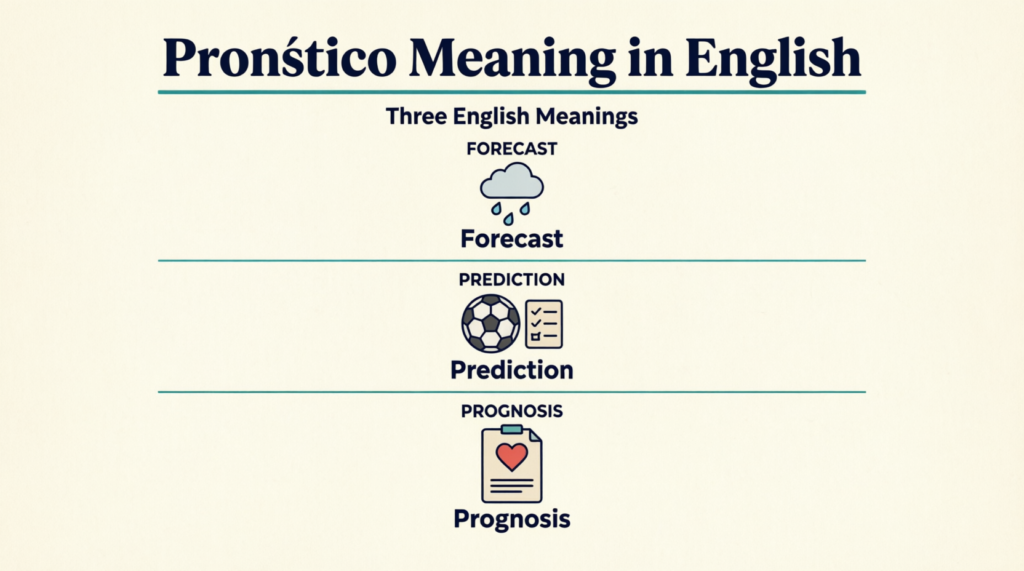
Pronóstico is a Spanish word that usually means “forecast,” “prediction,” or “prognosis” in English. Its exact translation depends on the context. It commonly refers to a weather forecast, a prediction about a future event, or a medical assessment of how an illness may develop.
Pronóstico Meaning in English & Definition
The Spanish word pronóstico means a forecast or prediction about something that is expected to happen. In medical contexts, it usually translates to “prognosis,” which describes the likely course or outcome of a disease or health condition.
The most appropriate English translation depends on how the word is used.
Here are the three main meanings:
- Forecast: An estimate of future conditions, especially the weather.
- Prediction: A statement about what someone believes will happen in the future.
- Prognosis: A medical assessment of the likely progression or outcome of a disease.
For example, pronóstico del tiempo means “weather forecast,” while pronóstico médico means “medical prognosis.”
The word can also appear in sports, economics, business, and everyday conversations about future possibilities.
Quick Translation Table
| Spanish expression | English translation |
|---|---|
| Pronóstico del tiempo | Weather forecast |
| Pronóstico meteorológico | Weather forecast |
| Pronóstico médico | Medical prognosis |
| Pronóstico favorable | Favorable prognosis |
| Pronóstico reservado | Guarded prognosis |
| Pronóstico deportivo | Sports prediction or forecast |
| Pronóstico económico | Economic forecast |
| Hacer un pronóstico | To make a prediction or forecast |
| Según el pronóstico | According to the forecast |
| Pronóstico de ventas | Sales forecast |
The easiest way to remember it: If the subject is weather, use “forecast.” If it is a general future event, use “prediction.” If it concerns a patient’s medical outlook, use “prognosis.”
Introduction
Have you ever seen the Spanish word pronóstico in a weather application, a sports discussion, or a medical report and wondered what it means in English? Although the word has several translations, understanding its context makes it relatively easy to interpret.
Spanish speakers use pronóstico when discussing what may happen in the future. A weather presenter might use it to explain whether rain is expected, a sports analyst might use it to predict a match result, and a doctor might use it to describe the likely course of a patient’s condition.
These situations share one central idea: an informed estimate of a future outcome.
However, pronóstico does not always mean that something will definitely happen. Forecasts and predictions are based on available information, evidence, patterns, or professional judgment. They may change as new information becomes available.
Learning this word is useful for Spanish learners, translators, travelers, students, and anyone who reads Spanish-language news or digital content.
In this guide, you will learn the English translations of pronóstico, how to use it naturally, where it comes from, and how it differs from similar Spanish words such as predicción, previsión, and diagnóstico.
Origin of Pronóstico
The Spanish noun pronóstico comes from Latin prognosticum, which is related to the Greek word prognōstikón. The underlying idea involves knowing or recognizing something in advance.
The Greek elements are commonly explained through pro- (“before”) and gnōsis (“knowledge”). This connection also helps explain the English word “prognosis.”
Over time, related words developed specialized meanings in different languages and professional fields.
In Spanish, pronóstico became a versatile term used to describe expectations about future conditions or outcomes. Its medical meaning is particularly close to the English word “prognosis,” while its everyday meaning often corresponds to “forecast” or “prediction.”
Read This Tagalog in English Words With Meaning: 100+ Everyday Filipino Words to Learn
How Its Meaning Developed
The concept of anticipating future events has long been important in areas such as medicine, agriculture, navigation, and weather observation.
- Medicine: Physicians assess the likely course of a condition based on symptoms, clinical findings, and other relevant information.
- Weather forecasting: Meteorologists estimate future atmospheric conditions using observations and forecasting models.
- Sports: Analysts use statistics, team performance, and other evidence to predict possible results.
- Business and economics: Professionals estimate future sales, demand, costs, and economic trends.
The modern Spanish word reflects this broad use of informed expectations.
Although the English terms “forecast,” “prediction,” and “prognosis” overlap, each has a different emphasis. A forecast often concerns changing conditions, a prediction is a broader statement about the future, and a prognosis is especially associated with medicine.
Popularity of Pronóstico
Pronóstico is a common Spanish word because it appears in everyday conversations as well as specialized professional settings.
Its popularity is closely connected to the importance of discussing future conditions. People want to know whether it will rain, how a football match might end, whether a business is likely to grow, or how a medical condition may develop.
Common Places Where You Will See the Word
1. Weather applications and news
Spanish-language weather reports frequently use pronóstico when presenting expected temperatures, rainfall, wind, or other conditions.
Example: El pronóstico anuncia lluvia para mañana.
English: “The forecast predicts rain for tomorrow.”
2. Hospitals and medical discussions
Healthcare professionals may use pronóstico to describe the expected course of a patient’s condition.
Example: El médico explicó que el pronóstico es favorable.
English: “The doctor explained that the prognosis is favorable.”
3. Sports websites and conversations
Sports commentators may use the term when discussing likely match outcomes or tournament results.
Example: Mi pronóstico es que el equipo ganará.
English: “My prediction is that the team will win.”
4. Business reports
Companies use forecasts to estimate sales, revenue, demand, and market conditions.
Example: El pronóstico de ventas para diciembre es positivo.
English: “The sales forecast for December is positive.”
5. General conversations
People can use the word when talking about expectations or likely outcomes in everyday life.
Example: ¿Cuál es tu pronóstico para el partido?
English: “What is your prediction for the match?”
Because the word works across these different contexts, recognizing the subject of a sentence is the easiest way to understand its intended meaning.
How Pronóstico Is Used
The word pronóstico is a masculine Spanish noun. Its standard plural form is pronósticos.
It commonly appears with words that identify the subject of a forecast or prediction.
1. Pronóstico del tiempo
This expression means “weather forecast.”
Example:
¿Cuál es el pronóstico del tiempo para mañana?
English: “What is the weather forecast for tomorrow?”
You might hear this phrase when planning a trip, deciding what to wear, or checking whether outdoor activities are likely to be affected by rain.
2. Pronóstico médico
This expression means “medical prognosis.”
Example:
El pronóstico médico depende de cómo responda el paciente al tratamiento.
English: “The medical prognosis depends on how the patient responds to treatment.”
In medicine, the prognosis concerns the likely future course of a condition. It is different from a diagnosis, which identifies or explains the condition itself.
3. Pronóstico deportivo
This expression refers to a sports prediction or forecast.
Example:
Su pronóstico para la final es una victoria por dos goles.
English: “His prediction for the final is a two-goal victory.”
Sports predictions may be based on statistics, recent performance, injuries, historical results, or expert opinions.
4. Pronóstico económico
This expression means “economic forecast.”
Example:
El pronóstico económico apunta a un crecimiento moderado.
English: “The economic forecast points to moderate growth.”
Economists and analysts use forecasts to describe possible changes in economic activity, employment, inflation, and other indicators.
5. Pronóstico favorable
This phrase means “favorable prognosis” in medicine or “favorable forecast” in other settings.
Example:
Los especialistas consideran que el pronóstico es favorable.
English: “The specialists consider the outlook favorable.”
The exact translation depends on whether the discussion concerns a patient’s health, a business situation, or another future outcome.
6. Pronóstico reservado
In medical contexts, pronóstico reservado usually means “guarded prognosis.”
It indicates that the outcome remains uncertain or that the situation requires caution. It should not automatically be interpreted as a definite prediction of death or recovery.
Example:
El paciente permanece bajo observación y su pronóstico es reservado.
English: “The patient remains under observation, and the prognosis is guarded.”
7. Hacer un pronóstico
This phrase means “to make a prediction” or “to make a forecast.”
Example:
Es difícil hacer un pronóstico sin más información.
English: “It is difficult to make a prediction without more information.”
This construction is useful when discussing an estimate based on incomplete or changing evidence.
Read This 444 Tattoo Meaning: Symbolism, Spiritual Signs, and Powerful Design Ideas
Pronóstico Examples
The following examples show how pronóstico changes meaning according to context and tone.
Friendly Examples
These examples represent natural, everyday Spanish conversations.
Example 1: Planning a picnic
Spanish: El pronóstico dice que hará sol el sábado.
English: “The forecast says it will be sunny on Saturday.”
Context: Friends are deciding whether to organize an outdoor activity.
Example 2: Talking about football
Spanish: Mi pronóstico es que nuestro equipo ganará 2-1.
English: “My prediction is that our team will win 2–1.”
Context: Someone shares a personal opinion before a match.
Example 3: Discussing a trip
Spanish: Revisé el pronóstico antes de salir de casa.
English: “I checked the forecast before leaving home.”
Context: A traveler checks the weather before starting a journey.
Example 4: Asking for an opinion
Spanish: ¿Cuál es tu pronóstico para este año?
English: “What is your prediction for this year?”
Context: Someone asks another person to share their expectations about the coming year.
Professional Examples
In professional settings, pronóstico often appears in reports, formal discussions, and analytical writing.
Example 1: Medical assessment
Spanish: El pronóstico del paciente dependerá de su respuesta al tratamiento.
English: “The patient’s prognosis will depend on their response to treatment.”
Tone: Formal and clinical.
Example 2: Business planning
Spanish: El pronóstico de ventas indica un aumento durante el próximo trimestre.
English: “The sales forecast indicates an increase during the next quarter.”
Tone: Professional and analytical.
Example 3: Weather reporting
Spanish: El pronóstico meteorológico prevé lluvias intensas en algunas regiones.
English: “The weather forecast predicts heavy rainfall in some regions.”
Tone: Neutral and informative.
Example 4: Economic analysis
Spanish: El pronóstico económico continúa sujeto a la incertidumbre del mercado.
English: “The economic forecast remains subject to market uncertainty.”
Tone: Formal and cautious.
Funny Examples
Although pronóstico is a neutral word, it can appear in humorous conversations.
Example 1: Weekend plans
Spanish: Mi pronóstico para el domingo: sofá, comida y cero planes.
English: “My forecast for Sunday: sofa, food, and absolutely no plans.”
Tone: Casual and playful.
Example 2: Exam preparation
Spanish: Mi pronóstico para el examen no es muy favorable.
English: “My prediction for the exam isn’t very promising.”
Tone: Self-deprecating humor.
Example 3: Football enthusiasm
Spanish: Mi pronóstico es una victoria histórica. Mi equipo todavía no está de acuerdo.
English: “My prediction is a historic victory. My team doesn’t agree yet.”
Tone: Lighthearted and humorous.
These examples illustrate personal predictions rather than established facts. The humor comes from the situation, not from the word itself.
Comparison With Similar Terms
Spanish has several words related to predictions, expectations, and future outcomes. Although they can overlap, they are not always interchangeable.
| Spanish word or phrase | English meaning | Main difference |
|---|---|---|
| Pronóstico | Forecast, prediction, prognosis | A general estimate of a future outcome |
| Predicción | Prediction | A statement about what may happen |
| Previsión | Forecast, anticipation, provision | Often emphasizes planning or anticipating needs |
| Diagnóstico | Diagnosis | Identifies or explains a present condition |
| Estimación | Estimate | An approximate calculation or assessment |
| Expectativa | Expectation | A belief or anticipation about what may happen |
| Informe meteorológico | Weather report | A report containing weather information |
| Perspectiva | Outlook, perspective | Describes the broader view of a situation or its prospects |
Pronóstico vs. Predicción
Both words can mean “prediction,” but their usage may differ slightly.
Pronóstico is especially common in weather forecasting, medicine, sports analysis, and other fields involving informed assessments.
Predicción is a broader term for stating what someone thinks will happen.
For example:
- El pronóstico del tiempo es favorable. — “The weather forecast is favorable.”
- Mi predicción es que ganará el equipo local. — “My prediction is that the home team will win.”
The distinction is not absolute. Spanish speakers may use pronóstico for sports predictions and predicción in scientific or technical discussions.
Pronóstico vs. Previsión
Previsión can mean “forecast,” “foresight,” or “planning,” depending on the sentence.
Example:
La previsión de gastos ayudará a controlar el presupuesto.
English: “The expense forecast will help control the budget.”
In some contexts, previsión emphasizes anticipating a situation and preparing for it, while pronóstico emphasizes estimating what is likely to happen.
Read This Sacred Heart Tattoo Meaning: Faith, Love, Pain, and Spiritual Strength
Pronóstico vs. Diagnóstico
These words are especially important to distinguish in medical settings.
A diagnosis identifies a disease or condition, while a prognosis estimates its likely course or outcome.
For example:
- El diagnóstico es una infección respiratoria. — “The diagnosis is a respiratory infection.”
- El pronóstico es favorable con el tratamiento adecuado. — “The prognosis is favorable with appropriate treatment.”
A diagnosis and prognosis answer different questions: “What is the condition?” and “What is likely to happen?”
Pronóstico vs. Estimación
Estimación means “estimate.” It usually emphasizes an approximate quantity, value, time, or result.
For example, a company might prepare an estimación de costos (“cost estimate”) and a pronóstico de ventas (“sales forecast”).
The first estimates how much something may cost. The second anticipates how sales may develop.
Alternate Meanings of Pronóstico
Although “forecast” and “prediction” are the most recognizable translations, pronóstico can have specialized meanings.
Medical Prognosis
In healthcare, the word describes the expected course or outcome of an illness or injury.
A prognosis may be described as favorable, unfavorable, uncertain, or guarded, depending on the clinical situation and the terminology used.
It is an assessment rather than a guarantee. Medical outcomes can vary between individuals.
Weather Forecast
In meteorology, pronóstico refers to anticipated atmospheric conditions, such as temperature, rainfall, wind, or storms.
For example, pronóstico de lluvia means “rain forecast.”
Sports Prediction
In sports, the term can refer to an expected match result, score, winner, or tournament outcome.
Such predictions are estimates, not confirmed results.
Economic or Business Forecast
In business and economics, pronóstico can describe anticipated sales, demand, revenue, or market trends.
These forecasts support planning and decision-making, but they may change when conditions change.
General Outlook
In everyday language, pronóstico may refer broadly to the expected outcome of a situation.
For instance, El pronóstico para el proyecto es positivo means “The outlook for the project is positive.”
The surrounding words help identify which English translation sounds most natural.
Professional or Polite Alternatives
When translating pronóstico into English, choose the wording that suits the subject and the level of formality.
| Context | Natural English expression | Example |
|---|---|---|
| Weather | Forecast | The forecast calls for rain tomorrow. |
| Sports | Prediction | My prediction is that the home team will win. |
| Medicine | Prognosis | The patient’s prognosis is encouraging. |
| Business | Projection | Our revenue projection has improved. |
| Economics | Economic outlook | The economic outlook remains uncertain. |
| General discussion | Expected outcome | The expected outcome is still unclear. |
| Formal analysis | Assessment | The assessment suggests moderate growth. |
| Planning | Outlook or forecast | The outlook for next quarter is positive. |
These words are related but not identical.
For example, “projection” often refers to a calculated estimate, while “assessment” describes a broader evaluation. “Prognosis” is the preferred term in many medical contexts.
How to Choose the Best Translation
Use these simple guidelines:
- Choose forecast when discussing weather or anticipated trends.
- Choose prediction when someone states what they think will happen.
- Choose prognosis when discussing a medical condition.
- Choose projection for calculated future figures, such as revenue or expenses.
- Choose outlook when describing the general prospects of a situation.
A natural translation preserves the intended meaning rather than replacing every occurrence of pronóstico with the same English word.
Common Mistakes When Translating Pronóstico
Spanish learners sometimes make translation mistakes because several English words can correspond to pronóstico.
1. Translating It as “Diagnosis”
This is one of the most important mistakes to avoid.
Pronóstico usually means “prognosis” in medical contexts, while diagnóstico means “diagnosis.”
Incorrect: “The doctor’s diagnosis is favorable,” when the Spanish sentence refers to un pronóstico favorable.
Better: “The doctor’s prognosis is favorable.”
2. Using “Prognosis” for Every Situation
Although “prognosis” is a valid translation, it sounds medical or technical in many everyday English conversations.
For weather, “forecast” is more natural.
For a football match, “prediction” is often more appropriate.
3. Assuming a Forecast Is Certain
A forecast expresses an expectation based on available information. It does not guarantee that the predicted event will happen.
For example, El pronóstico anuncia lluvia means that rain is forecast, not that rainfall is certain in every location.
4. Ignoring Context
The phrase surrounding pronóstico usually identifies the intended meaning.
Compare:
- Pronóstico del tiempo — weather forecast.
- Pronóstico médico — medical prognosis.
- Pronóstico de ventas — sales forecast.
- Pronóstico del partido — match prediction.
5. Confusing the Noun With Related Expressions
Pronóstico is a noun. Expressions such as pronosticar and hacer un pronóstico use different grammatical structures.
For example:
- El pronóstico es favorable. — “The prognosis is favorable.”
- Los expertos pronostican lluvia. — “Experts forecast rain.”
- Es difícil hacer un pronóstico. — “It is difficult to make a prediction.”
Understanding these structures helps you translate full sentences more naturally.
Quick Tips for Learning Pronóstico
Remembering the word becomes easier when you connect it with familiar situations.
- Connect it with weather: Pronóstico del tiempo means “weather forecast.”
- Connect it with medicine: Pronóstico médico means “medical prognosis.”
- Connect it with sports: Pronóstico deportivo means “sports prediction.”
- Look for context clues: Words about rain, health, sales, or matches usually reveal the intended meaning.
- Learn common combinations: Practice phrases such as pronóstico favorable, pronóstico reservado, and pronóstico económico.
- Avoid translating word for word: Choose the English expression that sounds natural in the specific situation.
- Practice complete sentences: Learning phrases in context is generally more useful than memorizing an isolated word.
- Remember the accent: The correct Spanish spelling is pronóstico, with an accent on the second-to-last syllable.
A useful memory trick is to associate pronóstico with something that has not happened yet but can be anticipated using available information.
FAQ: Pronóstico Meaning in English
1. What does pronóstico mean in English?
Pronóstico usually means “forecast,” “prediction,” or “prognosis” in English. The best translation depends on context. It commonly means “weather forecast” in meteorology and “prognosis” in medicine.
2. What does pronóstico del tiempo mean in English?
Pronóstico del tiempo means “weather forecast.” It refers to information about expected weather conditions, including temperature, rainfall, wind, and other atmospheric changes.
3. What does pronóstico mean in medical terms?
In medical terminology, pronóstico means “prognosis.” It describes the expected course or likely outcome of a disease, injury, or other health condition.
4. What does pronóstico favorable mean?
Pronóstico favorable usually means “favorable prognosis” in a medical context. In other settings, it can mean “favorable forecast” or “positive outlook.” The phrase suggests that the expected outcome is encouraging, but it does not guarantee a particular result.
5. What does pronóstico reservado mean in English?
In medical contexts, pronóstico reservado generally means “guarded prognosis.” It indicates uncertainty or a need for caution when assessing the likely outcome. Its precise interpretation depends on the clinical context.
6. What is the difference between pronóstico and predicción?
Both words can mean “prediction.” However, pronóstico is especially common in weather, medicine, and professional forecasting, while predicción is a broader term for a statement about what may happen. Their meanings can overlap.
7. What is the difference between pronóstico and diagnóstico?
Pronóstico means “prognosis” when used in medicine and describes the likely future course of a condition. Diagnóstico means “diagnosis” and identifies or explains the condition itself.
8. How do you pronounce pronóstico in Spanish?
The word is pronounced approximately proh-NOHS-tee-koh in English-friendly phonetic spelling. The stress falls on the syllable nós, which is why Spanish writes an accent over the ó: pronóstico.
Conclusion
The Spanish word pronóstico generally means “forecast,” “prediction,” or “prognosis” in English. Its central idea is an informed expectation about a future event or outcome.
The correct translation depends on the context. Use “weather forecast” when discussing atmospheric conditions, “prediction” for a general future event or sports result, and “prognosis” when referring to a medical condition.
It is also useful to distinguish pronóstico from predicción, previsión, and diagnóstico, since these related words have different shades of meaning.
For Spanish learners, the best approach is to study the word in common expressions and complete sentences. With a little practice, you can recognize its meaning in weather reports, medical discussions, business forecasts, and everyday conversations.