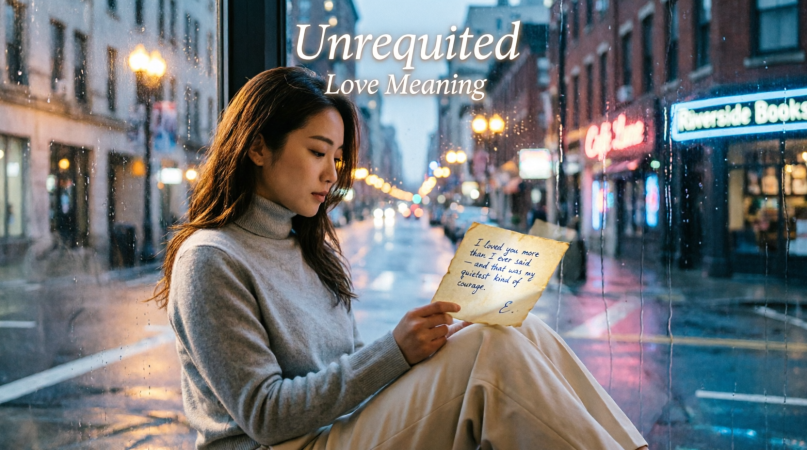
Unrequited love meaning loving or having romantic feelings for someone who does not feel the same way about you. It describes one-sided romantic affection that may involve longing, hope, sadness, or emotional disappointment.
Unrequited Love Meaning & Definition
The unrequited love meaning is simple: you love someone, but that person does not return your romantic feelings. You may think about them frequently, hope they will eventually fall for you, or wish your relationship could become something more. However, they may see you only as a friend, have feelings for somebody else, or simply not be interested in a romantic relationship.
For example, imagine you have developed strong feelings for a close friend. You enjoy spending time together, remember small details about their life, and imagine a future as a couple. One day, you discover that your friend sees you only as a friend. Your feelings are genuine, but they are not mutual. This is an example of unrequited love.
Unrequited love does not necessarily mean that the other person dislikes you or treats you badly. They might respect you, care about your well-being, and enjoy your company without experiencing romantic attraction.
What Does Unrequited Love Mean in Simple Words?
In simple words, unrequited love means loving someone who does not love you back in the same romantic way.
Here are a few everyday examples:
- You have a crush on someone who is interested in another person.
- You love a friend who does not want a romantic relationship.
- You have feelings for someone who does not know you exist.
- You want to date someone who has clearly said they are not interested.
The important point is that romantic feelings are not shared equally by both people.
Is Unrequited Love Always Painful?
Not necessarily, although it can be emotionally difficult. Some people experience sadness, rejection, jealousy, loneliness, or disappointment. Others accept the situation and move forward without prolonged distress.
The experience often becomes harder when someone continues to hope for a relationship despite clear signs that the other person does not feel the same way. Accepting reality, respecting boundaries, and allowing yourself time to heal can make the experience easier to manage.
Introduction
Have you ever cared deeply about someone while wondering whether they would ever feel the same way about you? Perhaps you have waited for a message, interpreted a friendly smile as a sign of romantic interest, or imagined what life would be like if the person you loved chose you.
These experiences help explain why unrequited love is such a familiar emotional theme in everyday life, literature, music, films, and social media.
Unlike mutual love, in which both people share romantic feelings, unrequited love involves an imbalance between what one person feels and what the other person feels. The person experiencing it may have sincere affection, but sincerity alone cannot create a mutual relationship.
Understanding this expression can help you describe your emotions more accurately, recognize the difference between friendship and romantic attraction, and communicate your feelings without putting pressure on another person.
It is also important to remember that unrequited love does not make someone weak, unattractive, or unworthy of affection. People cannot always control whom they develop feelings for, and romantic compatibility depends on more than one person’s willingness to love.
Origin of the Term Unrequited Love
The expression unrequited love combines two English words: unrequited and love.
The word unrequited means not returned, repaid, or reciprocated. It comes from the verb requite, which means to return a feeling, action, kindness, or service. Adding the prefix un- gives the word its negative meaning.
When combined, the expression describes love or affection that is not returned by the person receiving it.
The word requite has historical roots in English usage dating back several centuries. The broader idea of one-sided love, however, is much older than the modern expression itself.
Unrequited Love in Literature and History
One-sided romantic affection has appeared in stories, poetry, plays, and songs across many cultures. Writers have often used it to explore longing, rejection, idealization, sacrifice, and the difference between desire and reality.
In classical mythology and traditional storytelling, characters sometimes pursue people who do not return their affection. In later literature, unreturned love became a recurring theme in romantic poetry and novels.
William Shakespeare’s plays and sonnets, for example, explore complicated romantic feelings, desire, jealousy, and disappointment. Although not every portrayal is an example of strictly unrequited love, these themes help explain the expression’s enduring place in literature.
Today, the term is used in ordinary conversations as well as in literary criticism, relationship discussions, and online searches.
Popularity of Unrequited Love
Unrequited love remains a recognizable topic because it describes a situation many people can understand, whether they have experienced it personally or encountered it through stories and entertainment.
Why Is Unrequited Love So Commonly Discussed?
Several factors help explain its popularity.
1. It describes a recognizable emotional experience. People often search for language that helps them understand why their feelings are not returned.
2. It appears in entertainment. Romantic films, novels, television dramas, and songs frequently portray characters who love someone who cannot or does not love them back.
3. It encourages self-reflection. People may use the expression to understand their own experiences, distinguish hope from reality, or explain why a relationship never developed.
4. It is widely used online. Social media posts, relationship advice articles, poems, and captions frequently discuss one-sided affection.
Unrequited Love in Modern Relationships
In modern dating, unrequited love can arise in several situations. Someone may develop feelings for a friend, become attached to a person they have been messaging, or continue to love a former partner who has moved on.
Online communication can sometimes make these experiences more confusing. Frequent messages, likes, and friendly interactions may feel meaningful to one person while representing ordinary friendship to the other.
That is why clear communication matters. Rather than relying entirely on hints or assumptions, it is usually more helpful to consider what the other person actually says and does.
Popularity does not make unrequited love a desirable experience, nor does it mean every strong attraction will become one-sided. The term simply gives people a way to describe a particular kind of romantic experience.
How Unrequited Love Is Used

The expression is generally used as a noun phrase to describe a type of romantic affection or the experience of loving someone who does not return those feelings.
It can appear in personal conversations, relationship advice, creative writing, professional discussions, and social media captions.
In Everyday Conversation
People commonly use the term when discussing a crush, a complicated friendship, or a romantic disappointment.
Examples:
- “I think I’m experiencing unrequited love.”
- “Her novel explores the pain of unrequited love.”
- “He struggled to move on from his unrequited love.”
- “Sometimes, unrequited love teaches us about boundaries.”
These sentences use the expression naturally and clearly.
In Romantic Relationships
The term can describe a situation in which one person wants a relationship but the other person does not share that desire.
For example:
“I wanted us to become a couple, but she saw me only as a friend. I eventually realized that my feelings were unrequited.”
This example explains the emotional situation without blaming either person.
In Literature, Music, and Film
Writers and critics may use unrequited love to describe a character’s motivation, a song’s emotional theme, or a story about romantic longing.
For example:
“The film portrays unrequited love through a character who continues to hope for a relationship that will never happen.”
Here, the phrase describes a central theme rather than a real-life relationship.
In Social Media Captions
The term can also appear in reflective or emotional posts.
Examples include:
- “Learning to let go of unrequited love.”
- “Not every love story has two people choosing each other.”
- “Sometimes, the hardest goodbye is the one you make in your heart.”
These captions communicate sadness, acceptance, or personal growth without requiring a lengthy explanation.
Examples of Unrequited Love
The following examples show how the concept can appear in different situations and tones.
Friendly Examples
Friendly examples describe one-sided affection in a gentle, conversational way.
| Example | Context |
|---|---|
| “I have feelings for my friend, but they see me as a sibling.” | Romantic feelings are not mutual. |
| “He likes her, but she is interested in someone else.” | Two people have different romantic interests. |
| “I finally accepted that my crush does not feel the same way.” | Someone acknowledges the situation. |
| “She cares about him deeply, but only as a friend.” | Affection exists without romantic attraction. |
| “My unrequited love eventually helped me understand what I wanted in a relationship.” | The person reflects on the experience. |
Tone tip: Use gentle wording when discussing another person’s feelings. Saying that someone does not reciprocate your affection is often more respectful than suggesting they are cruel for not loving you back.
Neutral Examples
Neutral examples explain the situation without adding strong emotional judgments.
- “The story focuses on unrequited love between two childhood friends.”
- “His feelings remained unrequited after she declined his invitation to date.”
- “The poem describes the emotional effects of unrequited love.”
- “Unrequited love can occur even when two people have a positive friendship.”
- “She decided to move forward after realizing the relationship would not be mutual.”
These sentences are suitable for essays, discussions, reviews, and informational articles.
Professional Examples
In professional or academic writing, the phrase can be used to discuss literature, emotional experiences, or relationship themes in a measured way.
| Sentence | Appropriate context |
|---|---|
| “The novel presents unrequited love as a source of personal conflict.” | Literary analysis |
| “The character’s unrequited affection influences several major decisions in the story.” | Academic writing |
| “The poem explores longing and the difficulty of accepting unreturned affection.” | Literature review |
| “The film examines how one-sided romantic feelings can affect personal relationships.” | Film criticism |
| “The article discusses healthy ways to cope with unreciprocated romantic feelings.” | Relationship education |
In a workplace conversation, however, the expression may be unnecessarily personal unless the discussion specifically concerns literature, emotional well-being, or relationships.
Funny Examples
Unrequited love is often associated with sadness, but light humor can sometimes help people describe an ordinary crush.
- “My crush and I have a beautiful relationship: I think about them, and they think about lunch.”
- “My love story has one enthusiastic participant.”
- “I sent my heart a calendar invitation, but apparently the other person declined.”
- “My feelings are mutual with my diary.”
- “Cupid delivered the message, but the recipient never accepted the invitation.”
These jokes are playful rather than literal definitions. They work best when someone is comfortable joking about the situation and is not using humor to dismiss another person’s genuine distress.
Negative or Dismissive Examples
Some expressions communicate frustration, but they can sound harsh or judgmental.
- “I’m tired of chasing someone who doesn’t want me.”
- “I need to stop waiting for a person who has already said no.”
- “I’m done confusing wishful thinking with a relationship.”
These statements focus on the speaker’s decision to move forward. By contrast, saying “They owe me love after everything I’ve done” expresses an unhealthy expectation. Affection is not a debt, and another person is not obligated to return romantic feelings.
Examples With Emojis and Punctuation
Emojis and punctuation can change the emotional tone of a message.
| Message | Tone |
|---|---|
| “Unrequited love is hard sometimes. 💔” | Sad and reflective |
| “Learning to let go… one day at a time. 🌱” | Hopeful and gentle |
| “Well, that crush was a plot twist! 😂” | Playful |
| “I care about you, but I respect your feelings.” | Mature and considerate |
| “I need some space to move on.” | Direct and respectful |
A broken-heart emoji often signals sadness, while a growing plant can suggest healing. However, emoji meanings depend on context and the relationship between the people communicating.
Comparison With Similar Terms

Unrequited love is related to several other expressions, but the terms do not mean exactly the same thing.
| Term | Meaning | Main difference |
|---|---|---|
| Unrequited love | Romantic feelings are not returned. | Focuses on one-sided affection. |
| One-sided love | One person loves another who does not reciprocate. | A more conversational expression with nearly the same meaning. |
| Unreciprocated love | Love or romantic feelings are not returned. | A formal-sounding alternative. |
| Mutual love | Both people share romantic affection. | Feelings are returned by both people. |
| Crush | A strong romantic interest in someone. | A crush may be mutual or one-sided. |
| Infatuation | Intense attraction, often involving idealization. | Focuses on the intensity or nature of attraction. |
| Unrequited affection | Affection is not returned. | May describe friendship or family affection, not only romance. |
| Rejection | Someone declines romantic interest or an offer. | Describes an event or response, not necessarily a continuing emotional experience. |
| Forbidden love | Love that faces social, personal, or other barriers. | The feelings may be mutual despite the obstacles. |
| Heartbreak | Deep emotional pain following loss or disappointment. | Describes the emotional impact, not the specific type of love. |
| Long-distance love | Romantic feelings between people separated by distance. | The relationship may be entirely mutual. |
Unrequited Love vs. One-Sided Love
These expressions are often interchangeable. Unrequited love sounds more literary or formal, while one-sided love is straightforward and conversational.
For example:
- Literary: “The novel explores the tragedy of unrequited love.”
- Conversational: “I realized my love for him was one-sided.”
Both communicate that the romantic feelings are not returned.
Unrequited Love vs. Forbidden Love
Forbidden love involves a relationship or attraction that faces obstacles, such as family opposition, social expectations, or circumstances that make a relationship difficult.
The feelings may still be mutual.
Unrequited love, on the other hand, specifically concerns feelings that are not returned. A relationship can involve both forbidden and unrequited love, but neither term automatically implies the other.
Unrequited Love vs. a Crush
A crush is an attraction that may be temporary, developing, mutual, or one-sided. Unrequited love describes the lack of reciprocation.
You can have a crush that turns into a mutual relationship. You can also develop deeper feelings for someone who never feels the same way.
Alternate Meanings of Unrequited Love
The phrase generally refers to romantic feelings that are not returned. It does not have a widely established, unrelated everyday meaning.
However, the expression can be used in broader or figurative contexts.
Unrequited affection: Someone may care deeply about a friend or another person without receiving the same level of affection in return.
Unrequited admiration: A person may admire a public figure, artist, teacher, or someone they know without that admiration being personally returned. This is not necessarily romantic.
Unrequited devotion: Someone may dedicate considerable time or emotional energy to a person, cause, or ideal without receiving the response they hoped for.
These expressions extend the idea of unreturned feelings beyond romance. Still, when people use the exact phrase unrequited love, they usually mean one-sided romantic affection.
Professional or Polite Alternatives
Sometimes, unrequited love may sound too emotional, literary, or dramatic for the situation. Choosing an alternative can help you communicate more naturally.
| Alternative | Best use | Example |
|---|---|---|
| Unreciprocated feelings | Neutral or formal discussion | “I recognized that my feelings were unreciprocated.” |
| One-sided affection | Everyday conversation | “It was one-sided affection rather than a mutual relationship.” |
| Unreturned romantic feelings | Clear and direct communication | “I decided to move on from my unreturned romantic feelings.” |
| A lack of mutual romantic interest | Polite, professional, or counseling contexts | “There was a lack of mutual romantic interest.” |
| Feelings that are not mutual | Gentle personal conversations | “I understand that our feelings are not mutual.” |
| An unshared romantic interest | Neutral explanation | “The situation involved an unshared romantic interest.” |
| Unreciprocated attachment | Reflective or psychological discussion | “She wanted to understand her unreciprocated attachment.” |
Which Alternative Should You Choose?
Use one-sided love when talking casually with friends. Choose unreciprocated feelings when writing a formal explanation or discussing emotions in a neutral way. Use feelings that are not mutual when you want to communicate gently and clearly with another person.
For professional writing, avoid language that assigns blame or assumes the other person’s motives. “The romantic interest was not mutual” is more neutral than “The other person cruelly refused to love me.”
Common Mistakes When Using Unrequited Love
Although the expression is straightforward, it is easy to confuse its meaning or use it in situations where another term would be more accurate.
1. Confusing It With Forbidden Love
Unrequited love is not simply love that faces obstacles. The defining feature is that the feelings are not returned.
If two people love each other but their families oppose the relationship, forbidden love may be more accurate.
2. Assuming It Means Hatred
Someone who does not return romantic feelings does not necessarily dislike the person who loves them. They may care about that person as a friend without feeling romantic attraction.
3. Using It for Every Crush
A crush is not automatically unrequited. The other person may share the same interest, or their feelings may simply be unknown.
Use the term when the feelings are clearly not reciprocated or when the situation is understood to be one-sided.
4. Assuming Friendship Means Romantic Interest
Kindness, regular conversation, and emotional support can be signs of friendship rather than romantic attraction. It is important not to treat ordinary friendliness as proof that someone secretly wants a relationship.
5. Treating Love as an Obligation
Nobody owes another person romantic affection because they have received gifts, attention, or emotional support.
Healthy relationships require freely given, mutual interest and respect for personal boundaries.
6. Overusing the Phrase in Formal Writing
In academic or professional contexts, repeating unrequited love too frequently can make the writing sound repetitive or overly dramatic. Alternatives such as unreciprocated feelings, one-sided affection, and a lack of mutual romantic interest can improve variety when they accurately describe the situation.
Quick Tips for Understanding and Using the Phrase

Keep these practical points in mind when using or discussing unrequited love.
- Remember the central meaning: One person has romantic feelings that the other person does not return.
- Consider the context: The expression can be used in conversations, novels, films, songs, captions, and academic discussions.
- Choose the right tone: Use unrequited love for a literary or emotional tone and one-sided love for a more conversational tone.
- Avoid assuming motives: Someone may not return your feelings for many reasons, and you do not need to know every reason to respect their decision.
- Communicate honestly: If it feels appropriate and safe, express your feelings clearly without demanding a particular response.
- Respect boundaries: If someone says they are not interested, accept their answer rather than repeatedly trying to persuade them.
- Give yourself time: Emotional attachment may not disappear immediately. Spending time with supportive people and maintaining your usual routines can help.
- Focus on mutual relationships: Look for connections in which both people feel valued, respected, and willing to participate.
A useful reminder is that your feelings can be real even when a relationship is not mutual. Recognizing that difference allows you to respect another person’s choice without dismissing your own emotional experience.
FAQS
1. What does unrequited love mean in simple words?
Unrequited love means loving someone romantically who does not love you back in the same way. One person has romantic feelings, but the other person does not share them. It is another way of describing one-sided romantic affection.
2. Is unrequited love the same as one-sided love?
Yes, the expressions usually have the same meaning. Both describe romantic feelings that are not returned. Unrequited love sounds more literary or formal, while one-sided love is more common in casual conversation.
3. Can unrequited love happen between friends?
Yes. One friend may develop romantic feelings while the other person wants to remain friends. The friendship can still be meaningful, but the romantic interest is unrequited if those feelings are not returned.
4. Is unrequited love always painful?
No. It can cause sadness, rejection, or disappointment, but people experience it differently. Some accept the situation relatively quickly, while others need more time to process their feelings. The emotional impact often depends on the depth of the attachment and the circumstances.
5. What is an example of unrequited love?
A person falls in love with a close friend and hopes to start a romantic relationship. The friend explains that they care about them but do not feel romantic attraction. Because the feelings are not mutual, the situation is an example of unrequited love.
6. What is the opposite of unrequited love?
The closest opposite is mutual love, in which both people share romantic feelings. A reciprocated romantic relationship also describes a situation where both people willingly return each other’s romantic interest.
7. How do you use unrequited love in a sentence?
You can use it to describe a personal experience, a fictional character, or a literary theme. For example: “The novel explores unrequited love and the difficulty of accepting that two people want different things.”
8. How can someone move on from unrequited love?
Start by acknowledging your feelings without judging yourself. Accept the other person’s boundaries, reduce contact if you need emotional space, and spend time on friendships, interests, and personal goals. If the distress becomes overwhelming or interferes with everyday life, consider talking to a qualified mental health professional.
Conclusion
Understanding the unrequited love meaning helps you recognize and describe one of the most familiar experiences in romantic life: caring deeply for someone who does not return your feelings.
The phrase refers to one-sided romantic affection and is commonly used in everyday conversation, literature, films, songs, and relationship discussions. Although it is closely related to expressions such as one-sided love and unreciprocated feelings, it differs from a crush, forbidden love, and heartbreak.
If you experience unrequited love, remember that your feelings are valid, but they do not create an obligation for another person. You can respect their decision while giving yourself permission to grieve, establish boundaries, and move forward.
Ultimately, love is healthiest when it is freely shared. You deserve a relationship in which affection, respect, and romantic interest are mutual—not one in which you must continually convince someone to choose you.