
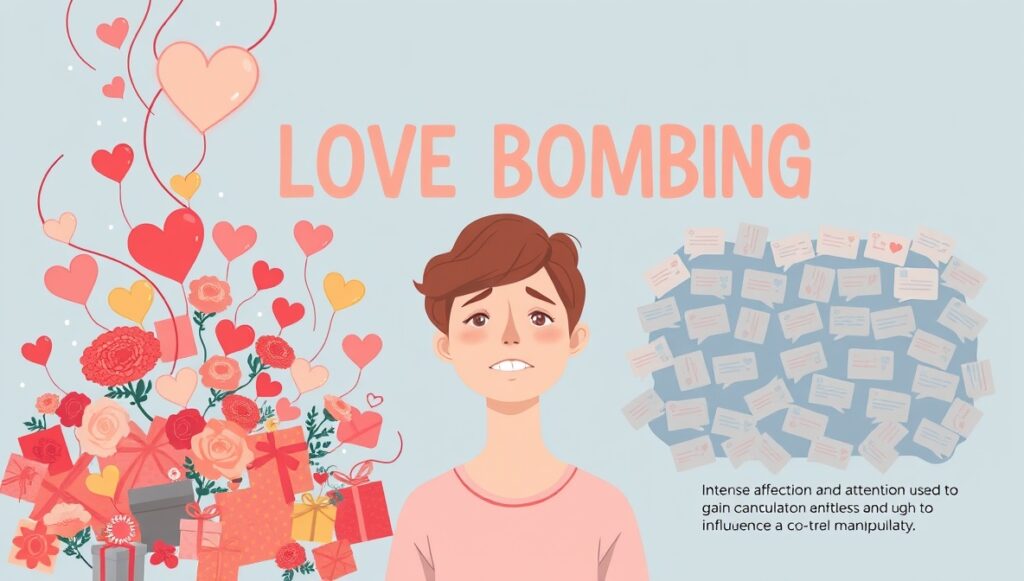
Love bombing means overwhelming someone with excessive affection, attention, compliments, gifts, or promises, often early in a relationship, to influence their emotions or gain control. Although intense affection can be genuine, love bombing becomes concerning when it is used to create pressure, emotional dependence, or an unhealthy relationship dynamic.
Love Bombing Meaning & Definition
The phrase love bombing meaning refers to a pattern in which someone gives another person an unusually intense amount of romantic attention, affection, praise, or gifts, sometimes to influence their feelings or behavior. It may happen during the early stages of dating, within an established relationship, or in other relationships where emotional influence is involved.
For example, someone you have just met might tell you that you are their soulmate, send dozens of messages every day, buy expensive gifts, and insist that you spend all your free time together. At first, this attention may feel exciting and flattering. However, if the person becomes angry when you need space or expects immediate commitment, the affection may be part of an unhealthy pattern.
Love bombing is not simply the act of being romantic. Healthy relationships can include frequent compliments, thoughtful surprises, affectionate messages, and strong feelings early on. The difference is whether the attention respects the other person’s boundaries, develops at a comfortable pace, and allows both people to make independent choices.
Common signs associated with love bombing include:
- Excessive compliments and declarations of love very early in a relationship.
- Constant messages or calls that leave little room for personal time.
- Expensive gifts that create a sense of obligation.
- Pressure to commit, move in together, or make major decisions quickly.
- Discomfort or anger when the other person asks for space.
- Affection that changes into guilt, criticism, or withdrawal when expectations are not met.
The key idea: Love bombing describes overwhelming affection that may be used to influence another person. The amount of affection alone does not prove manipulation; the surrounding behavior and repeated pattern matter.
Introduction
Imagine meeting someone who seems almost too good to be true. They compliment everything about you, message you from morning until night, talk about your future together after only a few dates, and repeatedly tell you that they have never felt this way about anyone else.
At first, it can feel like a dream relationship. You may feel appreciated, desired, and understood. But over time, the attention might begin to feel overwhelming. The person may expect you to reply immediately, become upset when you see friends, or treat your request for personal space as a sign that you do not care.
This is one situation in which people may use the term love bombing.
Understanding the meaning of love bombing can help you distinguish healthy romantic excitement from behavior that creates pressure or weakens personal boundaries. It is especially useful when discussing dating, relationship psychology, emotional manipulation, and unhealthy relationship patterns.
However, it is important not to label every enthusiastic partner as manipulative. People express affection differently, and some relationships naturally develop quickly. The concern arises when intense attention is paired with pressure, disregard for boundaries, or attempts to control another person’s choices.
This guide explains where the term comes from, how it is used, the signs people commonly associate with love bombing, and how it differs from genuine affection and other relationship behaviors.
Origin of the Term Love Bombing

The expression love bombing combines two words: “love,” referring to affection or emotional attachment, and “bombing,” suggesting an overwhelming amount of something delivered at once.
The term became associated with high-pressure group recruitment and influence during discussions of certain religious and ideological groups in the twentieth century. It described the practice of surrounding newcomers with unusually intense friendliness, attention, praise, and a sense of belonging.
Over time, the expression entered wider discussions of interpersonal relationships. It became especially associated with dating and romantic partnerships in which overwhelming affection may be used to gain trust, accelerate commitment, or influence another person’s behavior.
Read This 444 Tattoo Meaning: Symbolism, Spiritual Signs, and Powerful Design Ideas
In modern relationship discussions, love bombing is often mentioned alongside emotional manipulation, coercive control, unhealthy attachment patterns, and narcissistic relationship dynamics.
The meaning has broadened beyond its earlier associations. Today, people may use the term when discussing romantic relationships, friendships, family dynamics, or situations in which intense attention appears designed to create emotional obligation.
It is worth remembering that the phrase describes a behavior pattern, not a formal diagnosis. A person cannot be diagnosed with a personality disorder simply because they give many compliments, move quickly in a relationship, or behave affectionately.
Why Love Bombing Is Popular in Online Discussions
Love bombing has become a recognizable term in conversations about dating, emotional well-being, and relationship boundaries. Social media videos, personal stories, relationship advice articles, and online discussions frequently use it to describe intense attention that later becomes uncomfortable or controlling.
Several factors explain why people search for the meaning of love bombing.
1. Modern dating can move quickly. Messaging apps and social platforms make it easy to communicate throughout the day. Frequent communication can be enjoyable, but it may also create expectations that are difficult to maintain.
2. Early affection can feel confusing. People may struggle to determine whether an intense romantic connection is sincere enthusiasm or a sign of unhealthy pressure.
3. Relationship awareness has increased. More people are learning about emotional manipulation, consent, personal boundaries, and controlling behavior.
4. The term gives people a way to describe an experience. Someone who feels overwhelmed by attention may find it useful to learn the language associated with that experience.
5. Online stories can spread awareness. People share examples of excessive gifts, constant messaging, rushed commitment, and affection that changes after boundaries are established.
Although the term is useful, social media sometimes applies it too broadly. A partner who plans a thoughtful surprise or expresses love early is not necessarily love bombing. The pattern, intent, and response to boundaries provide more meaningful context than one romantic gesture.
How Love Bombing Is Used in Everyday English
The expression is mainly used in discussions about romantic relationships, emotional behavior, and manipulation. It can appear in personal conversations, counseling-related discussions, educational articles, and social media posts.
To Describe Overwhelming Romantic Attention
Someone may use love bombing when a new partner gives unusually intense attention before the relationship has had time to develop naturally.
Example: “He was sending me gifts every day and talking about marriage after our second date. My friend wondered whether it was love bombing.”
The sentence describes concern about the intensity and pace of the relationship. It does not, by itself, establish that manipulation occurred.
To Explain a Controlling Relationship Pattern
The phrase may describe affection that appears conditional on obedience, constant availability, or commitment.
Example: “She called it love bombing because his affection disappeared whenever she asked for time alone.”
Here, the concern is not merely that he was affectionate. It is that affection appeared connected to whether she met his expectations.
To Discuss Relationship Psychology
Writers, counselors, and educators may use the term when explaining emotional pressure and boundaries.
Example: “The article explains how love bombing can make it difficult to recognize unhealthy relationship patterns.”
In this context, the expression is used descriptively rather than as an insult.
To Share Personal Experiences
People may say they experienced love bombing when reflecting on an earlier relationship.
Example: “Looking back, I felt overwhelmed by the constant attention and the pressure to commit.”
This kind of statement describes the person’s experience. The term may help them explain why the relationship felt uncomfortable, although a full understanding requires consideration of the wider circumstances.
In Social Media Comments
The phrase also appears in short online comments, captions, and relationship advice videos.
Examples include:
- “Love bombing isn’t the same as healthy affection.”
- “Pay attention to how someone reacts when you set boundaries.”
- “Big promises are not a substitute for consistent behavior.”
- “A relationship should leave room for personal space.”
Online comments can raise useful questions, but they should not replace a careful assessment of an individual relationship.
Love Bombing Examples in Different Situations
Examples make the meaning easier to understand. The following scenarios are illustrative and show behaviors that may raise concerns when they form a repeated pattern.
Friendly or Romantic Examples
Not every example of intense affection is necessarily love bombing. These scenarios show the difference between warm gestures and behavior that may become pressuring.
| Situation | Example | What it may indicate |
|---|---|---|
| Early dating | “I’ve never met anyone like you. Let’s take our time and get to know each other.” | Strong interest expressed without rushing the other person. |
| Frequent messaging | “I love talking to you, but let me know if you need time to yourself.” | Affection combined with respect for boundaries. |
| Thoughtful gifts | “I saw this book you mentioned and thought you’d enjoy it.” | A considerate gesture without an obvious demand. |
| Very intense attention | “If you really loved me, you’d reply to every message immediately.” | Possible emotional pressure and disregard for personal time. |
| Rushed commitment | “We’ve known each other for a week, so you should cancel your plans and move in with me.” | Pressure to make a major decision before feeling ready. |
The important difference is whether affection leaves both people free to choose their own pace.
Professional Examples
Love bombing can also be used in discussions of workplace relationships, leadership, recruitment, and group dynamics. In professional settings, the term should be used carefully because excessive praise alone does not establish manipulation.
| Situation | Example | Why it may be concerning |
|---|---|---|
| Workplace recruitment | A recruiter promises an extraordinary future but pressures a candidate to accept immediately. | The candidate may not have enough time to evaluate the offer. |
| New employee relationship | A manager offers constant praise but later expects unpaid work in return. | Praise may be connected to unreasonable expectations. |
| Business partnership | A potential partner makes grand promises before sharing basic details. | The promises may create trust without sufficient evidence. |
| Group membership | A group showers newcomers with attention but discourages outside relationships. | Excessive attention may be paired with isolation or control. |
These examples illustrate situations that deserve closer examination, not automatic proof of love bombing. Clear agreements, consistent conduct, and the ability to say no are important in professional relationships.
Funny or Casual Examples
Friends sometimes use love bombing humorously to describe an exaggerated amount of attention. In these cases, the expression may be used loosely rather than as a serious assessment of manipulation.
| Scenario | Casual example | Intended tone |
|---|---|---|
| A friend sends many cute animal videos. | “You’re love bombing me with puppy videos!” | Playful exaggeration. |
| Someone brings several favorite snacks. | “This is a serious chocolate love-bombing campaign.” | Lighthearted humor. |
| A friend gives too many compliments before a favor. | “All these compliments—what do you want from me?” | Teasing suspicion. |
| Someone sends many affectionate messages. | “My phone is getting a full romantic workout today.” | Casual observation. |
In everyday jokes, people may use love bombing to mean “a lot of affection at once.” That casual use is not always the same as the more serious relationship concept.
Comparison With Similar Terms
Love bombing is often confused with genuine affection, infatuation, healthy courtship, and other forms of emotional manipulation. Understanding the differences helps avoid inaccurate assumptions.
| Term | Meaning | Key difference |
|---|---|---|
| Love bombing | Overwhelming affection that may be used to influence, pressure, or control someone. | Concern centers on the pattern and its relationship to boundaries or control. |
| Genuine affection | Sincere expressions of care, warmth, and appreciation. | Healthy affection respects the other person’s choices and pace. |
| Infatuation | Intense attraction or fascination with another person. | It can be overwhelming without necessarily being deliberately manipulative. |
| Honeymoon phase | The early stage of a relationship when excitement and affection may be especially strong. | Strong feelings can be mutual and healthy. |
| Flirting | Playful or romantic behavior intended to express interest. | Flirting does not inherently involve pressure or control. |
| Future faking | Making promises about a shared future without a genuine intention to follow through. | The central concern is misleading promises about what will happen later. |
| Gaslighting | A pattern of manipulation that causes someone to doubt their perceptions, memory, or understanding. | It targets a person’s confidence in their own perception of reality. |
| Emotional manipulation | Influencing someone’s feelings or behavior through pressure, guilt, deception, or other tactics. | It is a broader category that can include many behaviors. |
These terms can overlap, but they are not interchangeable. For example, someone might show intense infatuation without trying to control their partner. Another person might make grand romantic promises and then use guilt to force commitment. The wider pattern helps distinguish these situations.
Alternate Meanings of Love Bombing
The phrase has a fairly consistent core meaning, but it may be used differently depending on the context.
In romantic relationships: It usually describes overwhelming affection or attention that may be intended to accelerate emotional attachment or influence a partner.
In friendships: It may describe someone who becomes intensely attentive very quickly, particularly if that attention later comes with expectations or pressure.
In family relationships: It can describe excessive affection or gifts used to influence decisions, gain compliance, or make someone feel obligated.
In workplace or group settings: It may describe intense praise, attention, or welcoming behavior that appears connected to recruitment, loyalty, or control.
In casual conversation: People sometimes use the phrase jokingly to describe an unusually large amount of compliments, messages, or gifts.
The casual meaning should not be confused with a serious pattern of manipulation. The surrounding circumstances determine how the phrase is being used.
Read This Sacred Heart Tattoo Meaning: Faith, Love, Pain, and Spiritual Strength
Professional or Polite Alternatives to Love Bombing
Sometimes, you may want to discuss the behavior without immediately labeling a person or relationship. Neutral language can help explain concerns clearly, particularly in sensitive conversations or professional writing.
Consider these alternatives:
- Overwhelming affection: Useful when describing a large amount of romantic attention without assuming intent.
- Intense early attention: Appropriate when discussing a relationship that moves very quickly.
- Pressure to commit: Useful when the main concern is being pushed into a serious relationship.
- Boundary-crossing behavior: Appropriate when someone ignores requests for space or privacy.
- Emotionally manipulative behavior: Suitable when there is a broader pattern of using emotions to influence someone’s choices.
- Excessive praise or attention: Useful in workplace, group, or social contexts.
- Unhealthy relationship dynamic: A neutral phrase for describing a pattern that causes distress or limits independence.
For example, instead of saying, “My partner is definitely love bombing me,” you might say, “I’m feeling overwhelmed by the intensity of the attention, and I feel pressured to commit before I’m ready.”
This wording explains the concern without making a definitive claim about the other person’s intentions.
Common Mistakes When Understanding Love Bombing

People sometimes misunderstand the term because they focus on one behavior rather than the wider relationship pattern.
1. Assuming every romantic gesture is love bombing. Flowers, gifts, compliments, and affectionate messages are normal parts of many healthy relationships. Their presence alone does not establish manipulation.
2. Treating fast-moving relationships as automatically unhealthy. Some couples develop strong feelings quickly. What matters is whether decisions remain mutual and both people feel comfortable with the pace.
3. Ignoring reactions to boundaries. A person’s response when you say no, request time alone, or disagree may provide more useful information than the intensity of their early affection.
4. Assuming you must prove someone’s intention. You do not need to know exactly why a person behaves a certain way to recognize that their behavior makes you uncomfortable or that your boundaries are not being respected.
5. Using the term as a diagnosis. Love bombing is a description of behavior, not a diagnosis of narcissism or another mental health condition.
6. Confusing love bombing with gaslighting. Both can appear in unhealthy relationships, but they describe different patterns. Love bombing focuses on overwhelming affection; gaslighting involves undermining someone’s trust in their perceptions or memory.
7. Believing that every case follows the same pattern. There is no universal timeline or fixed list of behaviors that proves love bombing. Consider the full context rather than relying on one sign.
Quick Tips for Recognizing and Discussing Love Bombing
Keep these practical points in mind when interpreting the phrase or applying it to a relationship.
- Look for patterns, not isolated gestures. Repeated behavior provides more information than one unusually romantic day.
- Pay attention to your comfort level. You are allowed to want a slower pace, less frequent messaging, or more time with friends and family.
- Notice how boundaries are treated. Respectful partners may feel disappointed, but they should not use guilt or intimidation to force agreement.
- Compare promises with consistent actions. Grand declarations matter less than how someone behaves over time.
- Protect your independence. Healthy relationships leave room for personal interests, friendships, and individual decisions.
- Avoid diagnosing people from social media content. Online lists may help identify questions to consider, but they cannot establish what is happening in a particular relationship.
- Seek support if you feel controlled or unsafe. A trusted person or qualified counselor can help you evaluate the situation. If you fear retaliation, prioritize your safety when deciding whether or how to confront the person.
You do not have to prove that a relationship fits a particular label before asking for respect, taking space, or seeking support.
FAQ: Love Bombing Meaning
1. What does love bombing mean in a relationship?
Love bombing refers to overwhelming affection, attention, compliments, gifts, or promises that may be used to influence another person’s emotions or behavior. It becomes especially concerning when it is paired with pressure, control, or disregard for boundaries.
2. What are the signs of love bombing?
Possible signs include intense declarations of love very early, constant messaging, excessive gifts, pressure to commit quickly, and anger when a partner asks for space. These behaviors should be considered in context rather than treated as proof on their own.
3. Is love bombing the same as being in love?
No. Genuine love can involve excitement, affection, and frequent expressions of care. Love bombing describes an overwhelming pattern of attention that may be used to influence or control someone, particularly when boundaries are ignored.
4. Can love bombing happen at the beginning of a relationship?
Yes. It is often discussed in connection with early dating, when someone may use intense attention, grand promises, or rapid declarations of commitment. However, strong early attraction alone does not prove love bombing.
5. Is love bombing always intentional?
Not necessarily. The phrase is often used to describe behavior that may be manipulative, but it is difficult to determine another person’s intentions from affection alone. Focus on the behavior, its repeated effects, and whether your boundaries are respected.
6. What is the difference between love bombing and gaslighting?
Love bombing involves overwhelming affection or attention that may be used to influence a person. Gaslighting involves behavior that undermines someone’s confidence in their own perceptions, memory, or understanding of events. The two can occur in the same unhealthy relationship, but they are different concepts.
7. What does love bombing mean in texting?
In texting, love bombing may involve an unusually high volume of affectionate messages, constant demands for replies, intense declarations of love, or pressure to remain available all day. Frequent texting by itself is not enough to establish a concerning pattern.
8. How do you respond to love bombing?
Set clear boundaries, take time to make decisions, and observe how the other person responds. You can say that the relationship is moving too quickly or that you need more personal space. If you feel controlled or unsafe, seek support and prioritize your safety.
9. Can love bombing happen in friendships?
Yes. The phrase can describe overwhelming attention, gifts, praise, or pressure in a friendship when these behaviors appear intended to create obligation or control. However, enthusiastic friendship and generosity are not automatically manipulative.
10. Can love bombing be unintentional?
Intense affection can sometimes reflect excitement, insecurity, or different expectations about relationships rather than a deliberate plan to manipulate. The term is most useful when examining the wider pattern, especially whether affection is used to pressure someone or restrict their choices.
Conclusion
Understanding love bombing meaning can help you recognize the difference between intense affection and a relationship pattern that may involve emotional pressure or control. The term describes overwhelming attention, gifts, compliments, or promises that may be used to accelerate attachment or influence another person’s decisions.
However, affection is not automatically manipulation. Healthy partners can be enthusiastic, romantic, and expressive while respecting boundaries, accepting disagreement, and allowing relationships to develop at a mutually comfortable pace.
The most useful clues are the wider pattern of behavior, the consistency between words and actions, and the way a person responds when you express a need or say no. You do not have to label someone to recognize that a situation feels uncomfortable or that your boundaries deserve respect.
Ultimately, a healthy relationship should allow affection and independence to exist together. Strong feelings can bring people closer, but respect, trust, and consistent behavior help create a lasting connection.